
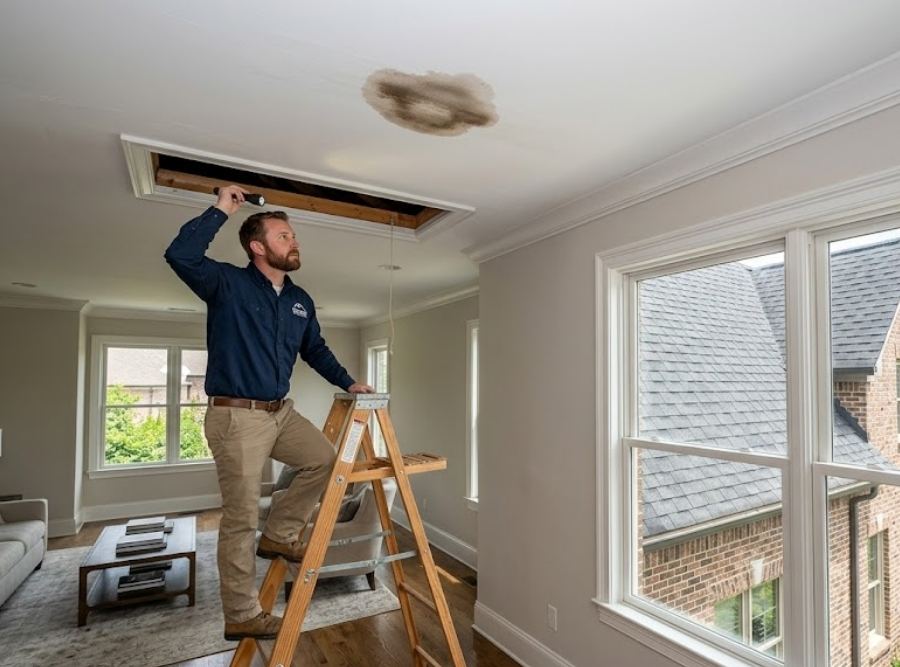
My Brentwood Roof Has a Dark Water Stain on the Ceiling but No Visible Missing Shingles — What Is Likely Causing It?
A dark ceiling stain with no visible missing shingles is often caused by failed flashing, a cracked pipe boot, a leaking valley, a roof penetration, or wind-driven rain getting beneath otherwise intact shingles. The stain may also come from attic condensation, which is why the roof, attic, insulation, and nearby plumbing should be inspected before the source is assumed.
A dark ring on the ceiling can be unsettling because the roof may look completely normal from the driveway. There may be no shingles in the yard, no obvious hole, and no steady dripping during ordinary rain. Yet the stain returns after the next strong Brentwood thunderstorm, spreads a little farther across the drywall, or develops a darker outline as it dries.
This is where homeowners often get caught off guard. Missing shingles are only one possible cause of a roof leak, and many of the most common leak sources are small details that cannot be seen from the ground. A narrow gap in chimney flashing, a split rubber pipe boot, a backed-out fastener, or a poorly draining valley can let water into the roof system while the surrounding shingles still appear intact.
The visible stain is also not a reliable map of where the water entered. Rain can travel across roof decking, along rafters, through insulation, and around framing before finally reaching the ceiling. Finding the actual source requires tracing the entire water path rather than simply repairing whatever sits directly above the stain.
The Shingles Can Look Fine While a Smaller Roof Detail Is Failing
Architectural shingles are designed to shed rain across the broad surface of the roof, but they cannot seal every transition on their own. Wherever the roof meets a chimney, wall, dormer, plumbing vent, skylight, valley, or exhaust opening, flashing and other specialized components are needed to redirect water around the interruption.
Those smaller components often age differently from the shingles. Rubber pipe boots can crack under ultraviolet exposure, sealants can become brittle, and metal flashing can separate slightly as temperatures change. A gap only a fraction of an inch wide may remain unnoticed during light rain but admit water when strong wind pushes rainfall against the roof from a particular direction.
This is especially common on Brentwood homes with steep pitches and complicated architecture. Properties in areas such as Annandale, Governors Club, Taramore, and Princeton Hills may have several valleys, dormers, chimneys, wall intersections, and roof penetrations. Each transition must remain integrated with the surrounding shingles and underlayment for the entire roof system to stay dry.
A roof can therefore have a localized leak even when the shingle field still has years of useful life. The goal of an inspection should be to identify that precise failure before assuming the entire roof needs replacement or covering the ceiling stain with another coat of paint.
A Cracked Pipe Boot Is One of the Most Common Hidden Causes
If the water stain appears near a bathroom, laundry room, or interior plumbing wall, a failed pipe boot is a strong possibility. Plumbing vent pipes extend through the roof and are sealed by flashing assemblies that usually include a rubber collar fitted tightly around the pipe. That rubber often deteriorates faster than the shingles around it.
Brentwood’s summer heat and direct sunlight gradually dry the collar until it becomes stiff and cracked. The vent pipe also expands and contracts as temperatures change, placing repeated stress on the same narrow section of rubber. Once the collar splits or pulls away from the pipe, rain can run down the vent stack and enter beneath the flashing.
The resulting stain may appear several feet from the pipe because water rarely falls straight down from the entry point. It can follow the decking or framing before soaking into insulation and drywall. Homeowners sometimes mistake this for an indoor plumbing problem because the moisture is near a bathroom, but a leak that appears only after rainfall points more strongly toward the roof penetration.
Repeatedly caulking the visible crack may slow the leak temporarily, but it does not restore the failed rubber. When the surrounding shingles are still serviceable, the better repair is usually to replace the pipe flashing correctly and inspect the decking beneath it for moisture damage.
Chimneys, Walls, and Dormers Depend on Flashing That Can Separate Over Time
A dark stain near a fireplace or exterior wall often leads back to step flashing, counterflashing, or another roof-to-wall transition. These metal pieces are layered with the shingles and built into the wall or chimney so water is directed onto the roof surface instead of behind it.
Flashing can fail even when it still looks generally intact. Thermal expansion may open a small joint, old sealant may pull away from masonry, or a previous repair may have relied too heavily on caulk instead of proper metal integration. Wind-driven rain then reaches behind the exposed edge and follows the wall or framing into the attic.
Chimneys are particularly vulnerable because masonry, metal, sealant, shingles, and roof decking all move differently as temperatures change. A repair that simply smears roof cement along the visible joint may conceal the opening for a while without correcting the underlying flashing detail. The stain returns when movement breaks the temporary seal or water finds another path behind it.
Older homes in Brenthaven, Meadowlake, and neighborhoods near Franklin Road or the Old Smyrna Road corridor may have flashing assemblies that have been repaired several times over the life of the roof. Each additional layer of sealant can make the original problem harder to see. A proper inspection should determine whether the flashing can be repaired locally or needs to be removed and rebuilt.
Roof Valleys Can Leak Without Any Shingles Being Missing
Valleys are the channels where two roof planes meet and direct a concentrated volume of water toward the gutters. During Brentwood’s prolonged downpours, valleys carry far more runoff than the open sections of the roof. Leaves, twigs, and organic debris can slow that flow, allowing water to remain against the shingles and flashing longer than intended.
A valley may leak because of poor installation, aged underlayment, damaged metal, misplaced nails, or deterioration beneath accumulated debris. The visible shingles on either side can remain in place while water moves beneath them through a vulnerable seam. In some cases, the problem only appears during very heavy rain because ordinary rainfall never creates enough volume to overwhelm the weak detail.
Large custom roofs with intersecting gables and multiple dormers often have several valleys carrying water into one area. Small installation errors can remain hidden for years before repeated storms and material aging turn them into active leaks. The ceiling stain may show up far below the lower end of the valley or along an interior wall where the water finally leaves the framing.
Clearing debris may improve drainage, but it will not repair damaged flashing or underlayment beneath the shingles. The valley needs to be inspected along its full length rather than patched only at the point closest to the interior stain.
Wind-Driven Rain Can Bypass Shingles That Still Look Intact
A roof that leaks only during storms with strong wind may have a weakness that ordinary rain does not expose. Shingles shed water most effectively when rain moves downward across the roof. Strong wind can force water sideways or uphill beneath shingle edges, against flashing, and into openings around vents or walls.
The shingles may also have weakened seals without being visibly displaced. Wind can lift a tab, break the adhesive bond, and allow the shingle to settle back into place afterward. From the yard, the roof still looks normal, but the compromised seal can admit water during the next storm from the same direction.
This pattern is common when homeowners say the stain appears only during “bad storms” or when the wind blows from one side of the house. The consistency of that behavior can help narrow the inspection toward specific roof slopes, flashing transitions, and penetrations exposed to that weather direction.
Brentwood’s mature tree canopy can make exposure even more uneven. Trees may shield one roof plane while directing wind and rain toward another, and falling limbs can disturb shingles or flashing without leaving a large visible opening. Storm history and roof orientation should therefore be considered along with the location of the ceiling stain.
The Stain May Come From Attic Condensation Instead of Rain
Not every dark ceiling stain is caused by exterior water entering through the roof. In some homes, warm humid air rises into the attic, contacts cold roof decking or metal components, and condenses into liquid water. That moisture can drip into insulation and eventually stain the ceiling even when the shingles and flashing are functioning properly.
Condensation is more likely when the attic has poor ventilation, significant air leakage from the living space, disconnected exhaust ducts, or high indoor humidity. Bathroom fans that terminate in the attic rather than outside can release large amounts of warm moisture directly beneath the roof. During colder weather, that moisture may collect on nails and decking before dripping onto the materials below.
The timing can help distinguish the two problems. A stain that worsens immediately after wind-driven rain suggests exterior intrusion, while recurring dampness during cold weather or periods of high indoor humidity may point toward condensation. The distinction cannot always be made from the room below because both conditions can produce similar brown rings, musty odors, and wet insulation.
Treating condensation as a shingle leak can lead to unnecessary roofing work, while blaming a true roof leak on humidity can allow decking damage to continue. A complete diagnosis should consider the roof exterior, attic airflow, insulation, exhaust ventilation, and the moisture pattern around the stain.
The Ceiling Stain Is Usually Not Directly Below the Leak
One of the most persistent misconceptions about roof leaks is that the damaged roofing component must be directly above the interior stain. Water follows the easiest available path, which may include roof decking seams, nails, rafters, trusses, insulation, wiring, and drywall joints.
A leak near a chimney can travel down a rafter and appear several feet away. Water entering around a pipe boot may follow the outside of the vent stack before moving across framing. A valley leak may run along the roof deck until it reaches a joint or fastener where it finally drops into the attic.
This is why caulking the roof directly above the stain often fails. The repair is based on interior location rather than the actual water path. It may also introduce sealant into an area that was draining properly while leaving the true failure untouched.
Professional leak tracing begins by matching the stain to attic evidence and then working uphill through the roof system. Dark decking, rusty fasteners, wet insulation, water trails, and damaged flashing can help establish the route. The goal is not simply to find something that looks imperfect, but to confirm how water is reaching the interior.
Small Fastener and Underlayment Failures Can Stay Hidden for Years
Not every hidden leak comes from a large flashing assembly. A nail driven too high, too low, or through an exposed section of shingle can create a narrow water path. Fasteners may also back out as materials expand and contract, lifting the shingle enough for rain to reach the opening.
Underlayment provides secondary protection when water gets beneath the shingles, but it is not permanent or immune to damage. Older felt can tear, synthetic underlayment can be punctured, and poorly overlapped sections may allow water to reach the decking. If the underlayment was installed incorrectly around valleys or penetrations, the roof can leak long before the shingles appear worn out.
These failures are especially likely to surface after years of heat, freeze-thaw cycles, and repeated storms. A roof installed incorrectly may remain dry during ordinary weather and then begin leaking when the right combination of wind direction and rainfall exposes the flaw.
This is another reason appearance alone is not enough to judge roof condition. A clean, uniform shingle surface can conceal weak details beneath it, while an older-looking roof may remain watertight because its flashing and underlayment were installed carefully.
Waiting for the Stain to Start Dripping Allows Hidden Damage to Spread
A small stain often feels easy to monitor because it dries between storms. The problem is that water may be reaching the attic long before enough accumulates to drip into the room. Insulation can absorb moisture repeatedly, and roof decking can remain damp after the ceiling surface looks dry.
Over time, the stain may darken, paint may blister, and the drywall may soften. Wet insulation loses performance and keeps adjacent wood damp longer, creating conditions where mold-like growth and wood deterioration can develop. If the water reaches a recessed light, ceiling fan, wiring, or electrical box, the issue becomes a safety concern rather than only a roofing repair.
A ceiling that begins sagging or bulging should not be ignored. Saturated drywall can release suddenly, especially if water has pooled above it. People and belongings should be moved away from the area, and electrical power may need to be shut off when moisture is near fixtures or wiring.
Early diagnosis usually offers more repair options. A pipe boot, flashing joint, localized valley problem, or small damaged section may be repairable before the decking and interior finishes require substantial work. Delay turns an exterior leak into a multi-layer restoration project.
A Real Roof Inspection Should Follow the Water, Not Guess at It
The correct repair depends entirely on the source. A cracked pipe boot may require a focused flashing replacement, while a chimney leak may call for rebuilt step and counterflashing. A valley problem could involve shingles, metal, underlayment, or drainage, and condensation may require attic ventilation and air-sealing corrections rather than exterior roof work.
A thorough inspection should start with the interior symptom and continue through the attic to the roof. The contractor should document the stain, wet insulation, decking condition, and visible water pathways before examining the corresponding roof slopes, penetrations, valleys, and flashing details. That process is much more reliable than applying sealant to several possible areas and waiting for another storm.
The age and condition of the surrounding roof also affect the repair. Flexible shingles may allow a localized component to be replaced cleanly, while brittle materials can crack when lifted. On a roof with several aging penetrations or widespread flashing problems, the inspection may reveal that the visible stain is only the first symptom of a larger system issue.
Red Rover Roofing can trace hidden leaks on Brentwood homes and explain whether the problem is isolated or connected to broader roof deterioration. The goal is to repair the actual pathway, protect the decking and interior, and avoid replacing sound roofing materials unnecessarily.
A Roof Can Look Fine From the Driveway and Still Need Prompt Attention
No visible missing shingles does not mean the ceiling stain is harmless or unrelated to the roof. Many leaks begin at pipe boots, chimneys, walls, valleys, vents, fasteners, and other details that cannot be evaluated from the ground. The water then moves through the structure before appearing in a location that may seem disconnected from the original entry point.
The most useful clues are when the stain appears, which weather conditions make it worse, and what can be seen in the attic. Photographing the stain after each storm, noting wind direction, and keeping the affected area accessible can help the inspection process. Painting over the mark or replacing drywall before the leak is corrected only removes visible evidence while the moisture continues behind it.
A dark ceiling stain is often an early warning rather than proof that the whole roof has failed. When the source is found quickly, the repair may remain limited to one penetration, flashing detail, or valley section. Addressing it before the next round of Brentwood storms is the best way to prevent a small hidden leak from becoming extensive damage to the roof deck, insulation, ceiling, and interior of the home.