What Actually Happens When the Crew Finds Rotten Roof Decking, and How Much Can It Add to My Brentwood Bill?
When rotten plywood or OSB is uncovered during a Brentwood roof replacement, the damaged sections must be removed and replaced before new underlayment and shingles can be installed. A few isolated sheets may add several hundred dollars to the project, while widespread deterioration can add several thousand; the actual increase depends on the number of sheets, roof access, wood type, framing damage, and the decking rate stated in the roofing contract.
Most homeowners expect a roof replacement to involve tearing off the old shingles and installing new ones. That expectation can change quickly when the crew removes the first section of roofing and exposes dark, soft, swollen, or crumbling wood beneath it. Suddenly, the project includes a material the homeowner may not have realized was part of the roof at all.
This is one of the most stressful moments in a roof replacement because the damaged wood was often hidden when the original estimate was prepared. A contractor can identify suspicious areas from the attic, visible sagging, recurring leaks, or soft spots, but the complete condition of the deck usually cannot be confirmed until the shingles and underlayment are removed. What looks like one small ceiling stain indoors may have affected several sheets of decking beneath a valley, chimney, pipe boot, or wall transition.
Finding rotten wood does not automatically mean the contractor is expanding the project unnecessarily. The decking is the structural surface that supports the underlayment, shingles, flashing, and roofing fasteners. If it cannot hold nails securely or provide a firm, flat substrate, covering it with new materials would compromise the new roof before the installation is complete.
The Roof Deck Is the Structural Surface Beneath Everything You See
Roof decking, also called roof sheathing, is the layer of wood fastened across the rafters or trusses. Most modern homes use sheets of OSB or plywood, although some older Brentwood homes may have dimensional boards or a combination of materials from previous additions and renovations. The underlayment and shingles are installed over this surface, making it the foundation of the roofing system.
Decking has several important jobs. It supports foot traffic during installation, holds roofing fasteners, helps distribute loads across the framing, and provides a continuous surface for the water-shedding layers above it. Shingles may be the visible part of the roof, but their performance depends heavily on the condition of the wood beneath them.
Healthy decking should be solid, reasonably flat, and capable of holding nails without excessive movement. Moisture-compromised decking may feel spongy, flex under pressure, separate into layers, or crumble around fasteners. OSB can swell and lose integrity after repeated saturation, while plywood may delaminate as its layers separate.
Once the wood reaches that point, installing new shingles over it is not a reasonable shortcut. Nails driven into deteriorated decking may not remain secure, which can contribute to loose shingles, uneven surfaces, and greater vulnerability during Brentwood’s high-wind thunderstorms. The damaged material must be removed so the new roof has a reliable base.
Why the Full Extent of the Damage Often Remains Hidden Until Tear-Off
A roofing contractor can look for warning signs before replacement begins, but there are limits to what can be confirmed through an exterior or attic inspection. The underside of the deck may be covered by insulation, finished ceilings, attic storage, or inaccessible roof sections. From above, the old shingles and underlayment conceal the surface entirely.
Some damage is visible in the attic as dark staining, mold-like growth, rusted nail points, or wood that has begun to sag. Other areas may look relatively normal from below even though the top layers have softened from years of intermittent moisture. A contractor may know that hidden damage is possible without being able to state exactly how many sheets will need replacement.
This commonly happens around valleys, chimneys, skylights, plumbing vents, dormers, and roof-to-wall transitions. A small flashing gap can admit water during wind-driven rain, allowing the deck to get wet repeatedly without producing a steady interior drip. By the time a ceiling stain appears, the moisture may have spread beyond the point where it first entered.
Homes in mature Brentwood neighborhoods such as Brenthaven, Meadowlake, River Oaks, and areas near Old Smyrna Road may also have roofs with several generations of repairs. Old patches can hide the original water path, while multiple layers of sealant may temporarily redirect water into nearby decking. The tear-off finally exposes the full history of the leak.
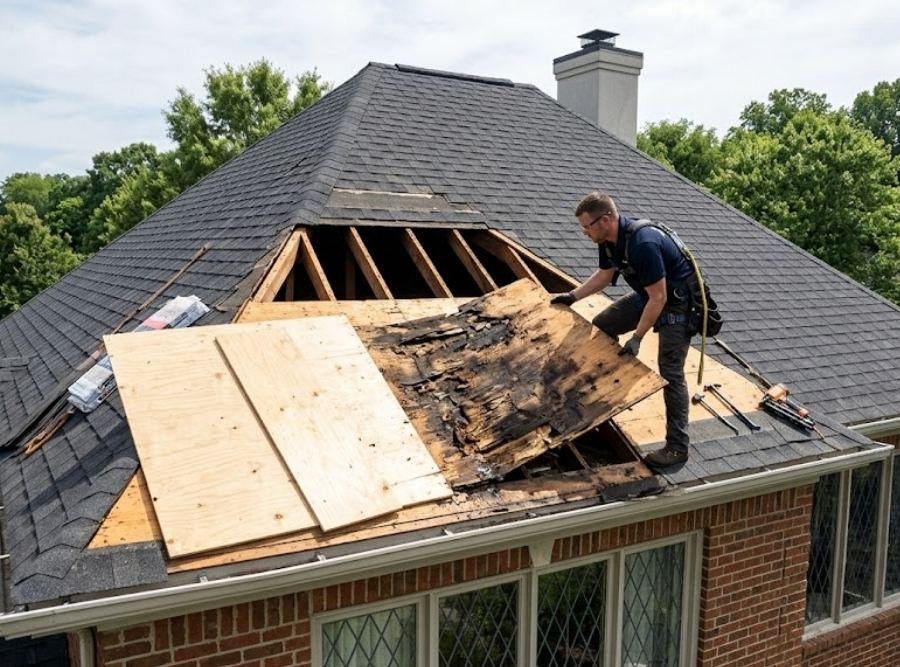
What the Crew Does After Rotten Plywood Is Exposed
When damaged decking is uncovered, the crew should pause work in that area and determine how far the deterioration extends. The decision should be based on the condition of the wood, not simply its color. Surface staining does not always mean the sheet has lost structural strength, while decking that looks only slightly discolored may be soft, swollen, or unable to hold a fastener.
The damaged section is marked and photographed so the homeowner can see what was found. The crew then removes the affected sheet or cuts back to sound material where an appropriate partial replacement is possible. Any replacement must be supported correctly along rafters, trusses, blocking, or panel edges rather than leaving unsupported seams beneath the new roof.
Once the compromised wood is removed, the framing below becomes visible. The crew can check whether moisture remained limited to the decking or affected rafters, trusses, fascia connections, or other structural components. Most hidden damage is localized when it is caught early, but long-term leaks can require additional carpentry beyond simply installing a new sheet.
New plywood or OSB of the appropriate thickness is then secured to the framing. The surface should align with the surrounding deck so the underlayment and shingles lie flat without dips or raised edges. After the wood replacement is completed, the roofing crew can resume installing the ice and water barrier, synthetic underlayment, flashing, and shingles over a sound substrate.
Why New Shingles Cannot Simply Cover the Bad Wood
When an unexpected cost appears during a roof replacement, homeowners understandably ask whether the damaged area can be left in place. It may seem reasonable if the wood is not visibly collapsing or if the interior has only shown a small stain. The problem is that decking does not have to be completely rotten to undermine the new roofing system.
Roofing nails depend on solid wood for their holding strength. If a nail enters swollen, delaminated, or deteriorated sheathing, it may not remain seated as the roof moves through heat, wind, and seasonal temperature changes. The shingle above it can loosen or lift even though the new material itself is not defective.
Soft decking also creates an uneven installation surface. Shingles may appear wavy, fasteners may be driven at inconsistent depths, and flashing components may not sit correctly around the damaged area. A visible dip or sag can remain after replacement because the structural problem was covered rather than corrected.
There is also no practical opportunity to replace the wood later without removing the new roofing above it. Saving money by leaving questionable decking in place can mean paying to tear out recently installed shingles when the area eventually worsens. Correcting the problem while the roof is already open is usually far less disruptive than returning after another leak.
How Rotten Decking Changes the Brentwood Roof Replacement Bill
Decking replacement is commonly priced by the sheet, by the square foot, or through a stated labor-and-material allowance in the roofing agreement. The charge should account for the replacement wood, removal and disposal of the deteriorated material, additional labor, fastening, and the time required to stop the normal installation process and rebuild the affected section.
If the crew finds one or two isolated damaged sheets, the increase may remain in the hundreds of dollars. A larger area involving several sheets can move into the low thousands, while widespread deterioration, difficult access, steep slopes, premium plywood, or damaged framing can add several thousand dollars to the project. The final number cannot be known responsibly until the damaged materials are exposed and measured.
This is why homeowners should ask about the decking rate before signing a roof replacement agreement. The contract should explain how replacement wood will be charged, whether a limited allowance is already included, what type and thickness of material will be used, and how approval will be handled if substantial damage is found. A clear rate does not predict the number of sheets, but it prevents the unit cost from becoming a surprise in the middle of the project.
The lowest initial roof estimate can become less attractive if it says nothing about decking or uses an unusually high change-order rate after work begins. A thorough proposal should acknowledge that hidden damage is possible and explain the process before the old roof is removed. That level of transparency is more useful than pretending there is no uncertainty beneath a twenty-year-old roofing system.
Why Two Contractors May Handle Decking Charges Differently
Roofing proposals do not all treat decking replacement the same way. One contractor may include a small number of sheets in the base price, another may charge for every sheet used, and a third may provide an allowance that applies only after a certain quantity is exceeded. Comparing only the total price without reading these terms can make two estimates appear more similar than they actually are.
The material specification also matters. OSB and CDX plywood are not priced or handled identically, and the correct thickness depends on the existing roof assembly, framing spacing, local requirements, and the roofing system being installed. A contractor should not substitute thinner or unsuitable material simply to reduce the change-order cost.
Labor conditions can affect the rate as well. Replacing one full sheet on a simple, walkable roof is different from rebuilding a deteriorated section around a steep valley, chimney, skylight, or multi-story roof edge. Partial panel work may require blocking, careful cuts, and additional flashing reconstruction that make the repair more involved than dropping a new sheet into an open area.
The homeowner should receive documentation showing how much decking was replaced and where it was located. Photos taken before the damaged material is removed are particularly valuable because the finished roof will conceal the repair completely. This protects both the homeowner and contractor by creating a clear record of why the additional work was necessary.
Rotten Decking Usually Points Back to a Water or Ventilation Problem
Replacing the wood solves the structural damage, but it does not automatically correct what caused the deterioration. If the crew installs new sheathing without repairing the leak or moisture source, the same problem can begin again beneath the new roof.
Localized rot commonly develops beneath failed pipe boots, chimney flashing, sidewall flashing, valleys, skylights, and roof penetrations. Water enters through a small opening, follows the decking, and repeatedly wets the same area. Because the leak may only become active during wind-driven rain, homeowners can go months between visible symptoms while the wood continues deteriorating.
Decking can also be damaged from below. Poor attic ventilation, air leakage from the living space, disconnected bathroom exhaust ducts, or excessive indoor humidity can cause condensation on the underside of the roof deck. In these cases, damage may be broader than the area surrounding one exterior leak and may appear as dark staining or moisture across several attic sections.
Brentwood’s hot, humid summers make attic moisture management especially important. A properly balanced system needs adequate intake and exhaust ventilation, but ventilation alone cannot overcome major air leaks or exhaust fans releasing moisture into the attic. The contractor should identify whether the damage came from exterior water intrusion, interior condensation, or a combination of both before closing the roof.
Older and More Complex Brentwood Homes Carry Different Hidden-Damage Risks
Brentwood’s housing stock ranges from ranch and traditional brick homes built in the 1960s through the 1980s to large executive and custom properties with complicated rooflines. The likelihood and pattern of hidden decking damage vary across those homes.
Older houses near Brenthaven, Meadowlake, Church Street, Franklin Road, and the Old Smyrna Road corridor may have aging sheathing, older flashing details, previous overlays, or several decades of repairs. The damage is often concentrated around penetrations and roof transitions, but years of intermittent leaks can allow it to spread farther than expected.
Larger homes in Annandale, Taramore, Princeton Hills, or Governors Club may have many valleys, dormers, chimneys, skylights, and intersecting roof planes. More transitions mean more places where flashing and drainage details can eventually allow moisture beneath the shingles. A single visible ceiling stain may be connected to a larger area of wet decking along a complex valley or wall intersection.
Tree coverage also affects drying. Shaded slopes remain damp longer after storms, and leaves can collect in valleys or against flashing. When water repeatedly enters a vulnerable detail, Brentwood’s humidity and limited sunlight can slow drying enough for deterioration to continue between rain events.
These conditions do not mean every older or complex roof will contain rotten wood. They explain why a contractor should discuss the possibility honestly instead of guaranteeing that the tear-off will uncover a perfect deck.
Does Homeowners Insurance Pay for Rotten Roof Decking?
Insurance treatment depends on what caused the damage and what the policy covers. Decking damaged directly by a covered storm event may be evaluated differently from wood that deteriorated gradually because of an old leak, poor maintenance, condensation, or long-term wear. Finding rotten plywood during an insurance-funded roof replacement does not automatically mean the additional wood will be covered.
The timing and documentation of the damage matter. Fresh damage associated with a tree impact or storm-created opening may be easier to connect to a specific event than widespread decay that developed over several years. Photographs, attic evidence, moisture patterns, and the location of the damaged decking can help clarify what happened.
Homeowners should avoid relying on the roofing contractor to promise an insurance outcome. The contractor can document the physical condition, explain why replacement is required, and submit relevant information when additional work is found. The insurance company determines whether that work falls within the policy and approved claim scope.
Even when the wood is not covered, it may still need to be replaced for the roofing installation to proceed correctly. Coverage and construction necessity are separate questions. A contractor should not install a compromised roof simply because the insurance estimate did not initially include the hidden condition.
The Warning Signs Often Appear Long Before the Roof Is Opened
Rotten decking is not always completely unexpected. A ceiling stain that keeps returning, a musty attic odor, darkened wood beneath a penetration, or a section of roof that looks wavy can indicate moisture problems before replacement begins. Shingles that repeatedly loosen in one area may also be attached to decking that no longer holds fasteners securely.
A soft or sagging section deserves prompt attention, but homeowners should not walk on the roof to test it. Deteriorated decking can fail beneath body weight even when the shingles above appear intact. A crew working on the roof should also identify and mark suspicious areas before tear-off so workers do not step onto weakened material unknowingly.
Attic inspections can reveal damp insulation, mold-like growth, rusted nails, water trails, and discolored sheathing. These signs may help the contractor prepare the homeowner for possible replacement, although they still may not show the full extent of damage across the top surface of the deck.
The earlier a leak or condensation problem is addressed, the more likely the decking repair will remain localized. Waiting until the roof visibly sags or the ceiling begins dripping allows moisture to spread into neighboring sheets, framing, insulation, drywall, fascia, and soffits.
A Quality Roofing Process Makes Hidden Wood Damage Clear, Not Mysterious
Unexpected decking replacement is easier to handle when the process is explained before tear-off. Homeowners should know the per-sheet or per-square-foot rate, the type of replacement material, whether any allowance is included, and who will be contacted if the damage exceeds the expected amount.
When rotten wood is found, the contractor should provide clear photographs and explain why the material cannot remain. The homeowner should be able to see whether the sheet is soft, swollen, delaminated, broken, or unable to hold fasteners. Broad statements that the wood is simply “bad” are less helpful than specific documentation.
The repair should also address the source. Replacing a damaged sheet beneath failed flashing without rebuilding the flashing would only reset the problem. Likewise, installing new decking over an attic with unresolved condensation may allow moisture damage to return from below.
Red Rover Roofing evaluates the deck as part of the complete roofing system rather than treating plywood as an isolated change order. That means documenting the damage, replacing only the wood that cannot perform properly, inspecting the framing beneath it, and correcting the leak or moisture condition responsible for the deterioration.
New Shingles Need Solid Wood Beneath Them to Perform Properly
Finding rotten plywood during a Brentwood roof replacement can increase the final bill, but leaving it beneath a new roof would be a much more expensive risk. The deck supports the fasteners, underlayment, flashing, shingles, and crew working above it. Once it has lost structural strength, it must be replaced before the roofing system can be rebuilt correctly.
A small amount of localized damage may add only several hundred dollars, while broader deterioration can add thousands. The most reliable way to avoid a financial shock is not to demand an unrealistic guarantee that no bad wood exists. It is to choose a contractor who explains the decking rate in advance, documents every affected area, and communicates before completing substantial additional work.
Homeowners should also remember that rotten decking is usually evidence of a deeper moisture issue. Correcting the plywood without addressing failed flashing, leaking penetrations, poor valley drainage, or attic condensation leaves the new roof vulnerable to the same failure. The right repair restores the structure and removes the reason it deteriorated.
A roof replacement should not hide what is underneath. It should provide the opportunity to uncover weak areas, rebuild them correctly, and give the new roofing materials a sound foundation for long-term performance.