The Best Flat Roof Contractor
in the Nashville Metro Area
Flat and low-slope roofs fail differently than pitched systems and get misdiagnosed more often. Red Rover Roofing installs, repairs, and rebuilds flat roof systems across the Nashville Metro Area, with drainage design and membrane selection matched to Middle Tennessee’s specific climate demands.
When Water Doesn’t Move, Problems Build Quietly
Flat and low-slope roofs are designed to shed water slowly, not hold it. When drainage is working correctly, water moves across the surface and exits through scuppers, internal drains, or gutters within a defined time window. When something interrupts that process, water ponds. And in Middle Tennessee’s climate, ponding water is more destructive than most homeowners realize.
The combination of high UV exposure and freeze-thaw cycles in late winter turns standing water into a mechanical failure mechanism. When water ponds for more than 48 hours on a low-slope surface, midday sun breaks down the molecular bonds of the membrane, TPO or EPDM from above, while winter freeze cycles expand trapped water at seams and scuppers from below. That’s not a leak that got worse over time. That’s a drainage problem that was never corrected, working against the system from both directions simultaneously.
What Recurring Flat Roof Leaks Actually Mean
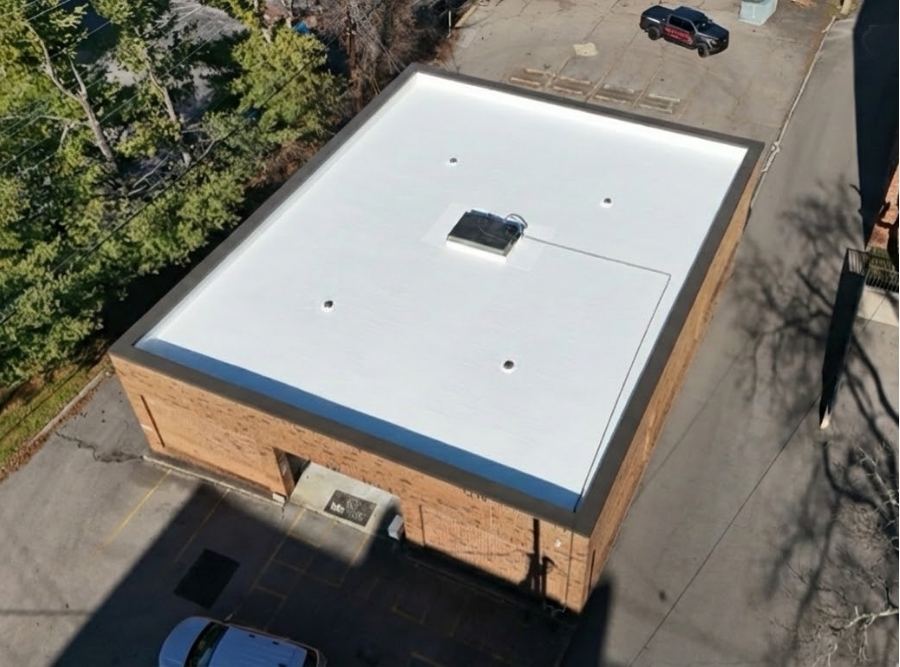
A homeowner came to us after patching the same section of a covered porch roof multiple times.
From inside the home, the leak appeared in the same spot after every significant rain. The assumption was a failing seam, a reasonable conclusion given how often the same area was affected.
Once we evaluated the roof surface, the actual cause was a low section where water had been ponding for extended periods. The standing water had put sustained pressure on the membrane and caused separation over time. The seam wasn’t the origin of the failure, it was where the failure showed up after the drainage problem had done its damage. After correcting the slope using tapered insulation and addressing the compromised membrane sections, the system stopped taking on water. That distinction, drainage cause versus surface symptom is where most flat roof repair cycles originate.
Get a free quote today and experience the difference of expert roofing done right!

“Red Rover Roofing exceeded our expectations from start to finish. Alex was professional, responsive, and incredibly knowledgeable throughout the entire process. He took the time to explain every detail, kept us informed, and delivered high-quality workmanship. The project was completed on time, and the results speak for themselves—our roof looks amazing. If you’re looking for a reliable and honest roofing company in Tennessee, I highly recommend Red Rover Roofing.” – Jessica T.
Roofing
Specialty & Gutters
Storm & Insurance
How We Approach Flat and Low-Slope Roofing
Drainage Assessment and Diagnosis
Before recommending materials or repair scope, we evaluate how water is currently moving across the roof. That means identifying low points, checking scupper and drain function, assessing membrane condition, and looking for areas where slope has been compromised by settling or improper installation. Drainage is the primary variable on a flat roof — surface repairs that don’t address drainage produce the same leak in a different location.
Installation or Repair
For new installations and full replacements, tapered polyiso insulation is installed to create a minimum 1/4-inch-per-foot slope, the 2026 Tennessee Residential Building Code standard for low-slope systems ensuring water reaches drainage points before it can dwell on the surface. Membrane selection follows after drainage design is established.
For repairs, the process starts with correcting the drainage condition before addressing surface damage. This includes seam reinforcement, membrane patching or replacement in affected sections, and scupper or drain clearing and resealing. Flashing at wall transitions and edges is inspected and corrected as part of every repair — wicking, where moisture travels backward under the membrane along wall junctions, is a consistent failure point on Middle Tennessee flat roofs and requires proper counter-flashing to prevent.
Verification
After installation or repair, drainage paths are verified under actual or simulated water flow. Seams, edges, and penetrations are checked for complete seal. The system is confirmed functional as a complete drainage assembly before the project is closed.
TPO vs EPDM in Middle Tennessee
Material selection on a flat roof isn’t one-size-fits-all in this region. Two variables define the right choice: sun exposure and debris environment.
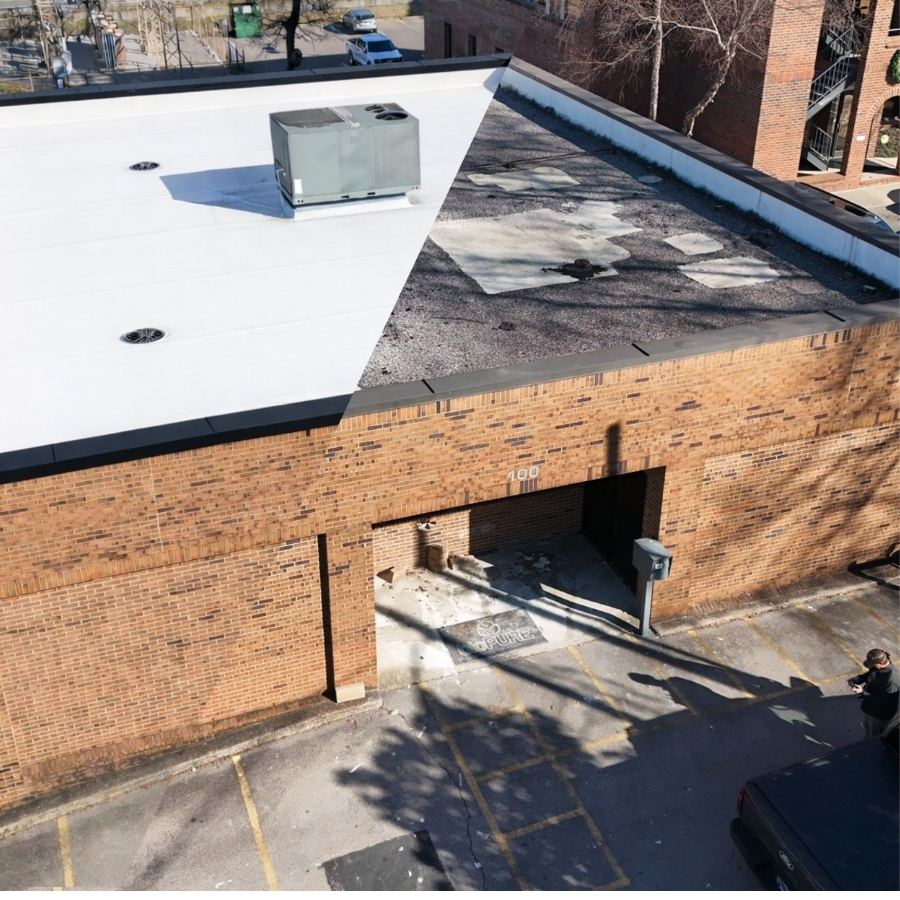
TPO (Thermoplastic Polyolefin) has become the standard specification for most Middle Tennessee residential flat roof applications. White TPO’s heat-welded seams eliminate the adhesive failure points that plague older membrane systems, and its high solar reflectivity reduces roof surface temperatures by up to 50°F compared to black EPDM. In Metro Nashville’s heat island environment where urban and suburban density keeps ambient temperatures elevated that thermal difference has a direct impact on cooling costs for sunrooms, flat-roof additions, and covered porch structures. TPO seams are fused rather than glued, which means they hold under thermal cycling without the adhesive degradation that causes EPDM seam failure over time.
EPDM (Ethylene Propylene Diene Monomer) remains the better specification for heavily wooded lots in areas like Green Hills, Hendersonville, and Brentwood where significant tree canopy is present. Fallen leaves and organic debris deposit acidic tannins on the membrane surface over time, TPO is more susceptible to tannin degradation than EPDM’s rubber composition. The tradeoff is that EPDM requires more frequent seam maintenance, since its adhesive-bonded seams are a weaker long-term joint than TPO’s heat-welded equivalent.
The right material depends on the site, not the price point. Both systems perform well when correctly installed with proper drainage design. Both fail quickly when drainage is inadequate regardless of which membrane is on top.
Red Rover Roofing Serves Middle Tennessee.
Serving homeowners across Williamson, Davidson, Rutherford, Maury counties and beyond.
Antioch, TN
Arrington, TN
Belle Meade, TN
Christiana, TN
College Grove, TN
Columbia, TN
Fairview, TN
Forest Hills, TN
Gallatin, TN
Goodlettsville, TN
Hendersonville, TN
La Vergne, TN
Lewisburg, TN
Mount Juliet, TN
Murfreesboro, TN
Nolensville, TN
Shelbyville, TN
Smyrna, TN
Thompson’s Station, TN
White House, TN
Don’t see your area? We constantly expand our service area to better serve homeowners in Middle Tennessee.
Tennessee Code Requirements for Low-Slope Drainage
Under the 2026 Tennessee Residential Building Code, all low-slope roof replacements require both a primary and a secondary emergency drainage system.
The secondary drain or overflow scupper is not optional, its purpose is to prevent water weight from exceeding structural load-bearing capacity if the primary drain becomes blocked. In Middle Tennessee’s high-pollen spring seasons, primary drain blockage is a recurring event on flat roofs without secondary drainage in place.
All drainage components must be integrated with watertight flashing to prevent wicking, the condition where moisture travels backward under the membrane edge and deteriorates the underlying wood structure from below. Counter-flashing at wall junctions, properly lapped and sealed, is what prevents this failure mode. We include both primary and secondary drainage and correct counter-flashing as standard scope on every flat roof installation and full replacement.
Common Questions About Flat and Low-Slope Roofing
Why is ponding water more destructive in Middle Tennessee than in other regions?
The combination of high UV exposure and freeze-thaw cycles makes ponding water here particularly damaging. Midday sun breaks down membrane molecular bonds from above while winter freeze cycles physically expand trapped water at seams and scuppers from below. Our 2026 installation standard uses tapered polyiso insulation to create a mandatory 1/4-inch-per-foot slope, ensuring water reaches drainage points before it can dwell long enough to damage the system.
Is TPO or EPDM better for a Middle Tennessee flat roof?
It depends on the site. White TPO is the standard for most applications — heat-welded seams, high solar reflectivity, and better performance in Metro Nashville’s heat island environment. EPDM is the better specification for heavily wooded lots where acidic tannin deposits from fallen leaves are a factor, as EPDM’s rubber composition resists tannin degradation better than TPO. Both systems require proper drainage design to perform long-term.
What does Tennessee code require for flat roof drainage?
The 2026 Tennessee Residential Building Code requires both a primary and a secondary emergency drainage system on all low-slope roof replacements. If the primary scupper or internal drain becomes blocked, the secondary drain prevents water weight from exceeding structural load capacity. All drainage components must be integrated with watertight flashing to prevent moisture from wicking backward under the membrane edge.
Why do flat roof leaks keep coming back after patching?
Recurring leaks on flat roofs almost always indicate a drainage problem rather than an isolated surface failure. When water ponds in a low section repeatedly, it applies sustained pressure to the membrane at that point — patching the surface doesn’t change where water collects. Correcting the slope with tapered insulation or improving drainage paths is what stops the cycle. Surface repairs without drainage correction produce the same leak in the same location after the next significant rain.
Get the Drainage Right First
On a flat roof, everything else follows from drainage. The right membrane installed over a drainage problem still fails, just more slowly. The right drainage design with a correctly installed membrane performs for decades.
Red Rover Roofing evaluates flat and low-slope systems across the Nashville Metro Area with drainage as the starting point, not an afterthought.
TN #12890 | ★★★★★ | BBB Accredited A− | NRCA Member | Nashville Chamber