What Are Common Signs a Roof Leak Is Coming From Flashing Instead of Shingles in Spring Hill, TN?
Quick Answer: Flashing is the more likely source when a leak appears near a chimney, dormer, skylight, plumbing vent, or roof-to-wall connection, especially during wind-driven rain. Shingle leaks are more likely when damage appears across the middle of an open roof slope.
Why Flashing Leaks Can Be Hard to Find
Flashing protects the places where a roof meets a wall, changes direction, or surrounds an opening.
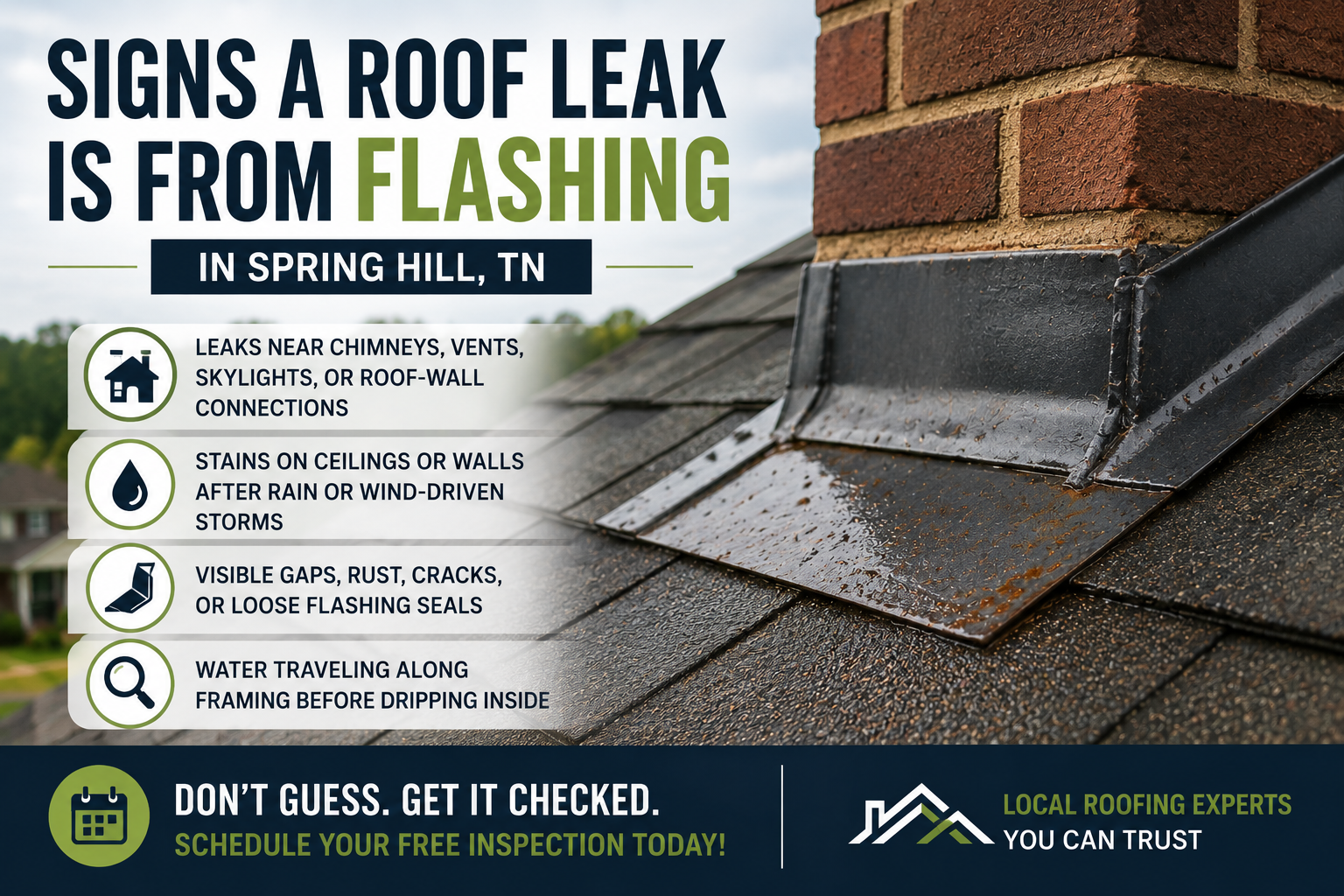
If the metal loosens, rusts, cracks, or pulls away, rain can get underneath the roofing.
The ceiling stain may not appear directly below the damaged spot. Water can travel along the roof decking or framing before it drips into the home.
That is why replacing a few shingles above a stain does not always stop the leak.
What Does Roof Flashing Do, and Why Does It Fail First?
Flashing is the metal, and sometimes rubber, that seals the places where the roof stops being a flat run of shingles: around chimneys, walls, dormers, skylights, valleys, and pipes. Shingles overlap one another to shed water down the slope. Flashing redirects water around anything that interrupts that slope.
It often fails before the shingles do for a few reasons. These transitions are where water collects and moves fastest, so they see more water than an open slope. The materials meeting at that joint, such as brick, siding, wood, metal, and asphalt, expand and contract at different rates through Middle Tennessee’s hot summers and cold snaps, which slowly opens small gaps. Rubber pipe boots dry out and crack in the sun, and sealant around the edges hardens over time. Many older leaks were also patched with caulk or roofing cement rather than new metal, and those patches tend to fail again.
That’s why a roof with plenty of shingle life left can still leak at one connection.
Start With the Location of the Stain
Where the water appears can offer one of the best clues.
A stain near a fireplace may point to the area where the chimney meets the roof. Water near a skylight may come from the seal, surrounding metal, or roofing just above it.
A mark where the ceiling meets an outside wall may be connected to the point where a lower roof slope meets a taller wall.
Leaks near plumbing pipes or exhaust vents may come from a cracked pipe boot or damaged collar.
Shingle damage is more likely when the problem begins away from walls and roof openings.
Does the Leak Appear During Wind-Driven Rain?
Leaks that show up only during certain storms may involve flashing.
Rain falling straight down may pass over a small opening. When wind pushes the water sideways, it can reach behind loose metal near a wall, chimney, or dormer.
This may be more noticeable during Middle Tennessee thunderstorms that bring heavy rain and changing wind direction.
A missing or badly damaged shingle may leak more consistently whenever water crosses that part of the roof.
The weather pattern does not prove the cause, but it can help narrow down where to inspect first.
Look for Gaps, Rust, or Loose Metal
Visible damage around a roof transition is another warning sign.
From the ground or another safe location, you may notice metal lifting away from a chimney or wall, rust, bent sections, cracked sealant, missing pieces, or a gap around an opening.
Heavy caulk or roofing cement may mean the area has been patched before. Those materials may slow the water for a while, but they will not correct damaged or poorly installed flashing.
Do not climb onto a wet or steep roof to check these areas. Red Rover Roofing offers drone-assisted roof inspections to examine hard-to-reach areas safely.
Is My Chimney Leak a Flashing Problem or a Roof Problem?
A chimney leak usually comes from one of three places: the flashing where the chimney meets the roof, the chimney itself, or the roof area just above it. Each one leaves slightly different clues.
- Flashing. If water shows up during wind-driven rain, or the stain sits where the chimney passes through the ceiling, the step flashing or counterflashing is the likely source. You may also see loose metal or heavy caulk at the joint.
- The chimney itself. A cracked chimney crown, a damaged cap, or worn brick and mortar can let water soak down through the masonry. Signs include damp brick in the attic, white mineral staining on the chimney, or water near the fireplace after long, steady rain with little wind.
- The roof above it. Water can pool against the uphill side of a wide chimney, especially if there’s no cricket to divert it. Wear on the nearby shingles can also let water in.
Because these causes can overlap, a roofer should check the chimney top, the flashing, and the attic before recommending a repair.
What Does Shingle Damage Usually Look Like?
Common signs include missing shingles, exposed nails, cracked tabs, lifted edges, worn surfaces, and heavy granule loss.
The damage is often in the middle of the roof slope rather than beside a wall, chimney, vent, or skylight.
Visible wear does not automatically prove that the shingles caused the interior stain. The surrounding area still needs to be checked before anyone recommends a repair.
Why Some Spring Hill Homes Have More Flashing Connections
Many Spring Hill homes have attached garages, multiple stories, dormers, and roof sections that meet at different heights.
A common example is a lower garage roof that meets the wall of a two-story section. Step flashing should carry water down the slope while siding or counterflashing protects the upper edge. If one part shifts or was installed incorrectly, water may get behind the wall.
Dormers also create several small joints close together. Water can enter along a sidewall, near a lower corner, or where the smaller roof joins the main slope.
These roof-to-wall areas and garage transitions deserve close attention on many newer Spring Hill homes.
Homeowners can read more about Red Rover Roofing’s roofing services for Spring Hill homes.
Can the Problem Be Repaired Without Replacing the Roof?
Often, yes.
A focused roof repair may be enough when the problem is limited to one connection or a small section of the roof.
The work may involve securing loose metal, replacing damaged flashing, repairing a pipe boot, replacing nearby shingles, or fixing a small area of wet decking.
The repair may be more involved if water has been entering for a long time or the surrounding shingles are brittle and badly worn.
The goal is to stop the path the water is taking, not simply cover the visible gap with more caulk.
How an Inspection Finds the Source
A good inspection should compare the location of the interior stain with the roof layout above it.
The roofer may check nearby wall transitions, pipe boots, valleys, dormers, and the main shingle surface. The attic may also need to be examined for damp insulation, wet decking, dark water marks, or stains along the framing.
Red Rover Roofing checks the problem area and nearby materials before recommending work. The inspection should show whether the leak is coming from failed flashing, damaged shingles, or more than one issue.
Regular roof maintenance and preventive inspections may also help catch loose materials and small gaps before water reaches the living space.
Frequently Asked Questions
Schedule a Roof-Leak Inspection in Spring Hill, TN
A stain near a dormer, plumbing vent, garage roof connection, chimney, skylight, or outside wall should not automatically be treated as a shingle problem.
Schedule an inspection with Red Rover Roofing to find out whether the leak needs flashing repair, shingle repair, or work on another roof component. You will receive photos, a clear explanation of what was found, and a practical repair recommendation.