
What Happens if I Don’t Fix My Flat or Low-Slope Roof Leak in Murfreesboro Before Winter?
For Murfreesboro property owners, leaving a flat or low-slope roof leak untreated before winter allows trapped moisture to freeze, expand, and worsen damage throughout the roofing system. What starts as a minor seam or flashing repair can lead to saturated insulation, damaged roof decking, interior ceiling stains, mold concerns, and significantly higher repair costs, including a partial or full roof replacement.
A low-slope roof leak rarely stays as simple as the stain visible inside the building. Water can enter through an open membrane seam, failed flashing, damaged HVAC curb, loose edge detail, or clogged drainage point and then travel horizontally through the roof assembly before it finally reaches a ceiling tile. By the time a bucket is placed under the drip, moisture may already be affecting insulation and decking several feet away.
Property owners sometimes decide to wait because the leak only appears during heavy rain or disappears once the weather turns dry. That pause can feel like evidence that the problem is minor, but flat and low-slope roofing systems often hold moisture where it cannot dry quickly. Murfreesboro’s fall rain, winter temperature swings, high humidity, and occasional freezes can turn hidden moisture into a much more expensive repair before spring arrives.
The most important reason to address the leak before winter is not simply to stop the next drip. It is to keep water from remaining inside the roof assembly long enough to damage materials that were still serviceable when the leak first began.
How Do Winter Freeze-Thaw Cycles Worsen Flat Roof Leaks?
A steep shingle roof relies heavily on gravity to move water toward the gutters. A flat or low-slope roof drains more slowly and depends on carefully designed slopes, scuppers, interior drains, membrane seams, flashing, and roof penetrations to direct water off the building. When one part of that system fails, moisture can remain on or inside the roof for much longer.
During Murfreesboro’s colder months, that moisture is repeatedly exposed to changing temperatures. Water entering a narrow seam or flashing gap can freeze, expand, and place additional pressure on the surrounding membrane. When temperatures rise again, the water thaws and can move farther into the insulation or substrate before the next freeze.
This repeated freeze-thaw movement does not require a long period of deep winter weather. A small number of temperature swings can enlarge an existing opening, weaken an adhesive bond, or separate materials that were already under stress. A leak that appeared only during the strongest fall storms may become active during lighter winter rain because the original entry point has widened.
Cold weather can also make some roofing materials less flexible. Aging membranes, sealants, and flashing details may not move as easily when temperatures drop, allowing existing cracks or loose transitions to become more pronounced. Waiting until spring gives the roofing system several more months of movement and moisture exposure before the underlying problem is addressed.
Why Does the Ceiling Stain Rarely Match the Actual Leak Source?
One of the most misleading things about a low-slope roof leak is the location of the interior drip. Water may enter beside an HVAC curb near one end of the roof, travel through seams in the insulation or along the deck, and appear above an office, hallway, warehouse rack, or tenant space some distance away.
Suspended ceilings can hide this movement for weeks. A tile may show one small brown spot while water is spreading across the insulation above it. The first visible symptom may not appear until the insulation becomes saturated or enough water collects to drip through a joint.
This is why replacing a ceiling tile or sealing the roof directly above the stain so often fails. The interior mark shows where water finally escaped the assembly, not necessarily where it entered. Effective leak tracing must follow the moisture through the deck, insulation, membrane, flashing, and drainage system rather than relying on a straight vertical line from the ceiling.
On commercial properties along Medical Center Parkway, Old Fort Parkway, Broad Street, or the Veterans Parkway corridor, roof penetrations and equipment can make these pathways especially complicated. HVAC units, pipes, curbs, expansion joints, and service traffic create multiple potential entry points across one large roof surface. A localized ceiling stain may be connected to a failure that is not visible from inside the occupied area.
Wet Insulation Can Turn a Small Repair Into a Much Larger Roofing Project
Roof insulation is designed to control heat flow, not to store water. Once moisture enters the assembly, polyiso or other insulation materials can lose thermal performance, become compressed, separate, or remain damp long after the exterior surface appears dry.
Saturated insulation also allows water to spread laterally. Instead of remaining under one small puncture or seam opening, moisture can move through adjoining boards and affect a much wider section of the roof. This is one reason a contractor may find more wet material than the interior leak initially suggests.
When wet insulation is trapped beneath a sealed roof membrane and above a heated interior ceiling, it creates an ideal dark, warm environment for rapid mold growth.
During winter, wet insulation becomes even more costly because it reduces the roof assembly’s ability to resist heat loss. The building may require more energy to maintain comfortable interior temperatures, while cold areas within the assembly can increase the chance of condensation and additional moisture accumulation.
Saturated roof insulation completely loses its R-value, meaning your commercial heating system will run constantly to compensate for the massive heat loss through the wet roof de
Drying the visible ceiling does not restore the insulation above it. Once the material is saturated or physically damaged, the affected section may need to be removed and replaced. Addressing the original leak early can preserve surrounding insulation and keep the repair limited to the failed seam, flashing, or membrane section.
Freeze-Thaw Cycles Exploit Open Seams, Cracks, and Loose Flashing
Membrane seams are among the most critical details on TPO, EPDM, and other low-slope systems. When those seams are welded, adhered, or taped correctly, they help create a continuous weather barrier across the roof. When a section begins separating, water can enter beneath the membrane even if the opening is too small to see easily from a distance.
Moisture inside an open seam can expand when frozen and place pressure on the bond. Repeated movement can make the opening longer or wider, especially on older roofs where adhesives and sealants have already lost flexibility. A repair that might have involved one short seam in the fall can become a broader membrane problem after several months of winter exposure.
Flashing details face similar stress. Parapet walls, roof edges, HVAC curbs, pipe penetrations, and expansion joints all move as temperatures change. If a termination bar has loosened, sealant has cracked, or flashing has begun pulling away, cold-weather movement can accelerate the separation.
Wind-driven winter rain can then force water into these small gaps. Because low-slope roofs drain slowly, water may remain against the weakened detail long enough to enter the assembly. The leak may become active only under a particular combination of wind direction, rainfall, and temperature, which can make the problem appear unpredictable even though the failure is steadily worsening.
Ponding Water Becomes More Dangerous When Drains and Scuppers Fill With Fall Debris
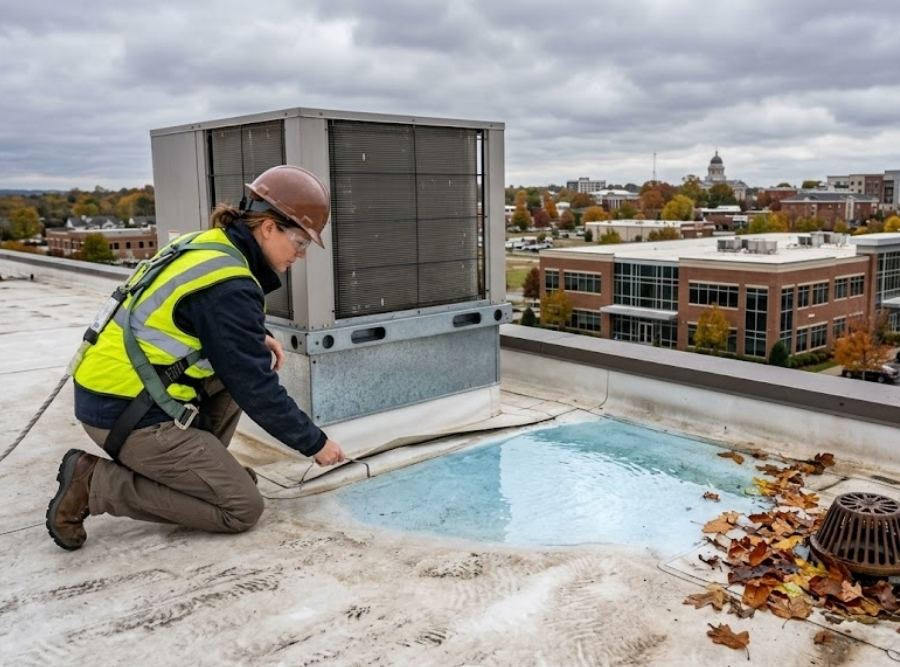
Water that remains on a low-slope roof after rainfall is often described as ponding. A brief amount of surface water after a storm may drain as the system catches up, but puddles that remain for extended periods indicate a drainage problem, surface depression, clogged outlet, or loss of slope within the roof assembly.
Autumn leaves, twigs, and other debris can clog scuppers, strainers, gutters, and interior drains across Murfreesboro. Buildings near mature trees in older areas around Downtown, East Main Street, North Highland Avenue, or established commercial corridors may see especially heavy seasonal buildup. Once the drainage path is restricted, ordinary rainfall can create deeper and longer-lasting ponding.
Standing water adds weight and keeps seams, flashing, and membrane surfaces continuously wet. It can also move into openings that would not leak under normal drainage conditions. If temperatures fall, ice may form around the drain or inside a low area, delaying drainage further and increasing stress on the surrounding materials.
If you notice ponding water that remains for more than 48 hours after a rainstorm, or if you feel a soft, spongy area when walking on the roof, call a commercial roofing contractor immediately—the structural decking may already be compromised.
Clearing accessible drainage points is a reasonable maintenance step, but it does not correct a roof that has lost slope or contains saturated insulation beneath a depression. Ponding can sometimes be the visible sign of a deeper problem, including compressed insulation, damaged decking, or an installation that never directed water properly in the first place.
TPO, EPDM, and Modified Bitumen Roofs Fail Differently in Cold Weather
Different low-slope systems respond to age, moisture, and temperature changes in different ways. TPO relies on heat-welded seams and carefully detailed transitions. A weak weld, damaged membrane, or stressed flashing point can begin separating under thermal movement and admit water beneath the surface.
EPDM is flexible, but older systems may shrink over time and pull against walls, curbs, seams, and termination points. As the membrane moves, flashing can lift or seams can open. Adhesives and tapes may also lose strength after years of heat, moisture, and rooftop exposure.
Modified bitumen systems often show cracking around transitions, repairs, penetrations, and areas of repeated movement. Surface coatings and asphalt-based materials can become less flexible as they age, allowing small cracks to expand during colder weather. Older repairs may also separate from the original membrane when the materials move at different rates.
None of these systems should be patched blindly based only on the visible symptom. The repair material must be compatible with the existing membrane, and the contractor needs to determine whether the problem is isolated or connected to broader saturation, shrinkage, flashing deterioration, or drainage failure.
Rooftop HVAC Equipment Creates Some of the Most Persistent Leak Paths
HVAC equipment is common on Murfreesboro offices, retail centers, schools, medical buildings, apartment properties, restaurants, and warehouses. Every rooftop unit sits on a curb or support system that must be integrated carefully with the roof membrane and flashing.
Maintenance traffic around these units can wear the roof faster than less-used areas. Tools may be dropped, panels may be stepped on repeatedly, and service personnel can unintentionally damage seams or flashing while accessing the equipment. Condensate lines may also discharge onto the roof in ways that keep certain areas wet.
When water appears below an HVAC unit, property owners often assume the mechanical equipment is leaking. That is possible, but the actual source may be curb flashing, a nearby seam, a penetration, or ponding water around the unit. The location should be evaluated from both the roofing and mechanical sides before either trade is blamed.
Winter increases the urgency because HVAC demand rises while the roof remains exposed to rain and temperature changes. Water entering around a curb can affect insulation, electrical components, ceiling systems, and occupied areas beneath sensitive equipment. Repairing the roofing detail before cold weather helps reduce the chance of an emergency call when the building depends most heavily on the rooftop unit.
A Soft Roof Surface Often Means the Damage Has Moved Below the Membrane
A membrane can look relatively normal while the materials beneath it are no longer sound. If maintenance personnel notice a soft, spongy, or unusually flexible area, wet insulation or damaged decking may already be present below the surface.
This condition creates a serious safety concern. Foot traffic can compress wet insulation further or place pressure on a weakened wood or metal deck. The membrane may then puncture, tear, or stretch over the damaged area, creating another entry point.
A soft area should not be explored casually by walking across it. The roof should be evaluated by someone who understands the system, knows how to approach suspected weak sections, and can use moisture-detection methods or controlled test cuts where appropriate.
If the leak is addressed before saturation spreads, the contractor may be able to remove and replace a limited section of membrane, insulation, and cover board. Once the soft area expands, the repair becomes more disruptive and may require deck replacement, larger membrane removal, and more interior protection below the work zone.
Waiting Until Spring Can Increase Both the Roofing Cost and the Interior Loss
Property owners sometimes postpone a low-slope repair because winter feels like a quieter season for roof work. In reality, waiting can add several layers of expense that would not have been part of the original repair.
Wet insulation may need replacement. Wood decking can soften or rot, while metal decking may corrode. Interior ceiling tiles, drywall, insulation, paint, flooring, inventory, office equipment, and electrical systems can all be affected as the leak continues.
Business interruption can become one of the largest costs. A small repair scheduled before winter may require limited access to the roof and a short work window. An emergency leak over occupied offices, patient areas, classrooms, retail inventory, or warehouse products can force areas to close, employees to relocate, or tenants to be moved.
The repair itself also becomes harder when the exact entry point has been obscured by several months of additional moisture movement. What began as one failed seam may develop into multiple wet areas, making diagnosis and restoration more involved. Early intervention preserves more of the existing roof and gives the property owner more scheduling control.
Should I Just Use Roof Cement to Seal the Leak Temporarily?
A visible crack near a flashing joint or seam often tempts maintenance personnel to apply caulk or roofing cement. A compatible temporary repair can sometimes reduce immediate water entry, but repeatedly covering the area without understanding the system can create larger problems.
Incompatible sealants may not adhere properly to TPO, EPDM, or modified bitumen. Some can damage the membrane, interfere with future welding or adhesion, or make a professional repair more difficult. Thick applications may also redirect water toward another weak point without correcting the original failure.
Roof coatings present a similar risk when used without moisture testing. Applying a coating over saturated insulation does not remove the water trapped below. It may seal moisture into the assembly while making the roof look cleaner from above.
A successful repair should identify the entry point, determine how far moisture has spread, remove damaged materials where necessary, and rebuild the affected section with products designed for that roofing system. The goal is not to cover the symptom before winter; it is to restore the roof’s ability to drain and remain watertight.
Is It Safe to Just Replace Stained Ceiling Tiles and Wait Until Spring?
Suspended ceiling tiles make interior leak damage easy to hide. A stained tile can be removed and replaced quickly, giving the room a clean appearance while the roof assembly remains wet above it.
If the leak continues, the new tile will stain or sag as well. More importantly, the materials above the ceiling may remain damp enough to support mold growth, corrosion, and deterioration. Water can also travel to light fixtures, wiring, ductwork, or neighboring rooms before the next visible stain appears.
A ceiling tile that feels heavy, bulges, or begins separating should be treated carefully because it may be holding water. Occupants and equipment should be moved away from the area until the condition is assessed. Electrical power may also need to be addressed when water is near fixtures or wiring.
Interior repairs should occur only after the roof source has been corrected and the cavity has been evaluated for moisture. Otherwise, the building owner is paying repeatedly to repair the final symptom while the actual failure continues above it.
Older Murfreesboro Commercial Roofs Are More Likely to Have Several Problems at Once
Low-slope roofs often begin with isolated seam or flashing problems in their earlier years. As the system ages, membrane movement, sealant deterioration, fastener stress, ponding, and repeated repairs can combine into a broader pattern of failure.
Buildings developed during earlier commercial growth along Memorial Boulevard, Broad Street, Old Fort Parkway, and South Rutherford Boulevard may have roofs that have already received several patches or overlays. Each repair can solve a specific problem, but repeated work may also make it harder to understand the original assembly and where moisture has traveled.
Rapidly developed areas around Medical Center Parkway, The Avenue, Blackman, Veterans Parkway, and Interstate 24 contain newer commercial roofs, but age alone does not eliminate risk. Poor drainage, weak seam welding, heavy rooftop traffic, or improperly detailed equipment curbs can create early failures even on a relatively young system.
The decision between repair and replacement should be based on the roof’s overall condition, not simply its installation year. A fifteen-year-old roof with dry insulation and one repairable seam may still have useful life. A younger roof with widespread saturation, poor slope, and repeated flashing failures may require a much broader correction.
What a Proper Pre-Winter Inspection Should Actually Evaluate
A low-slope roof inspection should begin with the leak history. The contractor needs to know when the water appears, whether it drips during or after rainfall, which wind direction makes it worse, and whether the stain has moved or expanded.
The roof surface should then be evaluated for open seams, membrane punctures, blisters, wrinkles, shrinkage, loose flashing, failing edge metal, damaged penetrations, and ponding. Drains, scuppers, gutters, and overflow paths should be checked for debris and signs that water regularly backs up.
HVAC curbs, pipes, pitch pockets, expansion joints, parapet walls, and termination bars deserve close attention because they often fail before the open membrane field. The inspector should also look for signs of heavy foot traffic, previous incompatible repairs, and soft areas suggesting wet insulation or deck deterioration.
When moisture beneath the membrane is suspected, additional testing may be necessary to define the affected area. That information helps determine whether a localized repair is enough or whether insulation and membrane must be removed across a larger section. Without understanding the moisture boundary, a surface patch may close one opening while leaving damaged materials underneath.
Repairing Before Winter Preserves More of the Roof You Already Own
Not every low-slope leak requires full replacement. A properly identified open seam, isolated flashing failure, damaged pipe detail, or localized membrane puncture may be repairable when the surrounding roof remains dry and structurally sound.
The advantage of acting early is that the repair can remain focused. The contractor may be able to clean and rebuild one seam, replace a small flashing section, correct drainage, or remove a limited wet area before moisture reaches adjacent insulation and decking.
Once the roof remains wet through winter, the restoration scope can expand significantly. Several insulation boards may need removal, deck repairs may become necessary, and the surrounding membrane may have to be replaced to create reliable tie-ins. What looked like a small maintenance cost in the fall can become a capital project by spring.
A pre-winter repair also gives the owner time to plan. Materials, access, tenant communication, interior protection, and work scheduling can be coordinated under controlled conditions rather than during an active leak or cold-weather emergency.
The Best Time to Address a Murfreesboro Low-Slope Leak Is Before the Next Freeze
A flat or low-slope roof leak does not become less important when the rainy season slows. Water already inside the system remains capable of damaging insulation, decking, flashing, and interior materials through the winter. Freeze-thaw cycles, blocked drainage, and repeated thermal movement can make the original opening larger while spreading moisture farther from the entry point.
The safest response is to document the interior leak, protect equipment and occupied areas, keep drains clear where that can be done safely, and schedule a roof-system inspection before colder weather sets in. Avoid walking across soft or wet sections and do not apply random coatings or sealants that may be incompatible with the membrane.
Red Rover Roofing can inspect TPO, EPDM, modified bitumen, and other low-slope systems throughout Murfreesboro, trace the moisture path, and determine whether the roof needs a focused repair, wet-insulation removal, flashing reconstruction, or a broader replacement plan. The goal is to stop the leak while the surrounding system is still worth preserving.
Waiting until spring may feel easier in the moment, but winter rarely leaves an active low-slope leak unchanged. Fixing the failure early protects the roof deck, reduces interior disruption, and gives the property owner more control over the cost and timing of the work.