
How Do I Tell if My Franklin, TN Roof Has Hail Damage That Insurance Will Actually Cover Versus Normal Wear?
Insurance generally looks for sudden, identifiable damage caused by a specific hailstorm rather than gradual aging, fading, blistering, or ordinary granule loss. Covered hail damage may include fractured shingle mats, fresh impact marks, displaced granules, damaged ridge caps, and matching dents on gutters or roof vents, but the final decision depends on the inspection findings and the terms of your policy.
After a hailstorm moves through Franklin, homeowners often walk outside expecting to see obvious roof damage. They look for missing shingles, holes, or large broken sections and assume the roof is fine when everything still appears intact from the driveway. Then a neighbor starts replacing their roof, dents become noticeable on the gutters, or a contractor points out dark impact marks that were not visible from the ground.
That is when the hardest question begins: is the roof truly hail-damaged, or is someone mistaking normal wear for storm damage?
The distinction matters because an older asphalt roof can have granule loss, fading, brittle edges, manufacturing blisters, previous repairs, and storm damage at the same time. Insurance coverage is generally tied to direct physical damage from a covered event, not to the fact that a roof is old or ready for replacement. A careful inspection must separate what happened suddenly during the storm from deterioration that developed gradually over years of Franklin heat, humidity, and weather exposure.
Covered Hail Damage Usually Has a Storm Pattern, Not Just an Old-Roof Appearance
Normal roof aging tends to develop gradually and more consistently across exposed areas. Granules loosen over time, asphalt dries out, shingle edges become brittle, and south- or west-facing slopes may show heavier wear because they receive more direct sun. These changes can make the roof look faded, uneven, or thin without proving that hail caused functional damage.
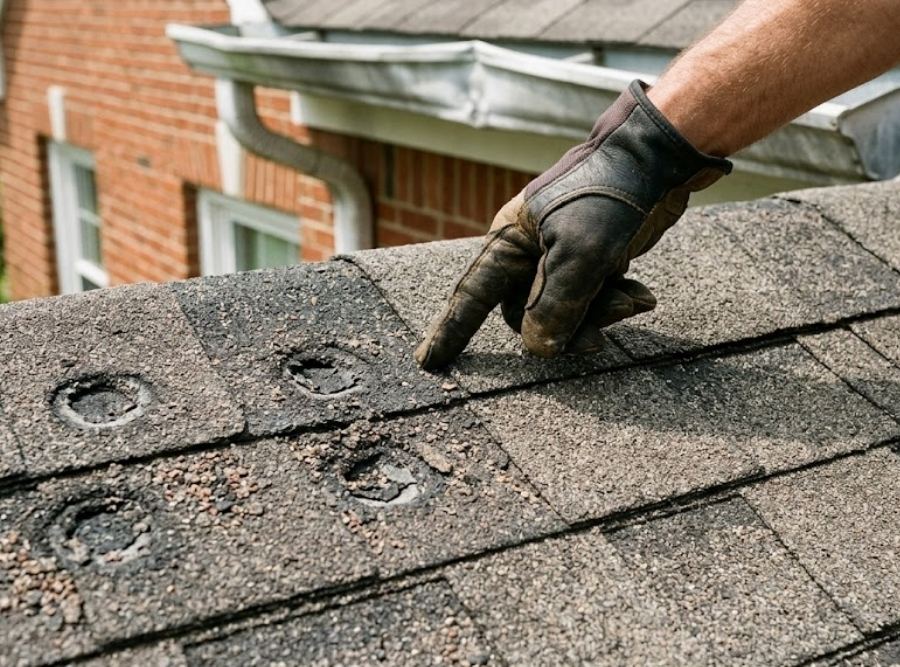
Hail impacts usually create a different pattern. Marks may appear randomly across the slope rather than evenly along shingle edges or drainage paths. A meaningful impact can displace granules, bruise the asphalt layer, or fracture the fiberglass reinforcement within the shingle even when the surface does not look dramatically broken.
The age of the damage also matters. Fresh hail marks may have sharply displaced granules and darker exposed asphalt, while older weathered areas often appear more blended into the surrounding surface. That visual difference is not always enough to establish the cause, but it helps an experienced inspector compare recent impacts with long-term deterioration.
The roof’s exposure should also fit the storm. Hail damage may be heavier on one or two slopes because of wind direction, roof pitch, mature tree cover, and the storm’s path across the property. Insurance does not necessarily require identical marks on every roof plane for storm damage to exist.
A Hail Bruise Is More Than a Spot Where a Few Granules Are Missing
Granules protect the asphalt shingle from ultraviolet exposure and physical wear. Hail can knock some of them loose, but missing granules alone do not automatically prove covered damage. Granules also shed because of age, foot traffic, manufacturing conditions, rain runoff, and ordinary weathering.
A more meaningful hail impact may compress or fracture the shingle beneath the surface. Contractors often describe this as a bruise because the impact area can feel softer than the surrounding material. The shingle may remain watertight immediately after the storm, yet the damaged asphalt and fiberglass mat can deteriorate faster under continued sun and rain.
That hidden damage is why homeowners should not wait for an active leak before having a hail-exposed roof evaluated. A storm-damaged shingle can continue lying flat while its protective surface and internal reinforcement have been weakened. Leaks may not appear until months or years later, after ultraviolet exposure and temperature changes enlarge the damaged area.
At the same time, not every soft or dark mark is a hail bruise. Blistering, mechanical damage, tool marks, foot traffic, tree debris, and manufacturing irregularities can create similar-looking spots. A reliable diagnosis considers the shape, pattern, location, surrounding collateral damage, and known storm conditions rather than relying on one isolated mark.
Gutters, Vents, and Other Soft Metals Help Confirm What Happened
One of the most useful ways to distinguish hail from ordinary roof aging is to inspect the rest of the property. Asphalt shingles weather gradually, but metal components often preserve clearer evidence of a recent impact event.
Fresh dents may appear on gutters, downspouts, roof vents, flashing, metal chimney caps, or HVAC equipment. Window screens, painted surfaces, outdoor furniture, and mailbox tops may also show impact marks that align with the storm date. These are commonly called collateral indicators because they help establish that hail reached the property.
Collateral damage does not automatically prove that the shingles sustained functional damage. Metal can dent under an impact that does not fracture a particular roofing material. It does, however, provide important context when the shingle marks, storm direction, and exterior damage form a consistent pattern.
A complete Franklin hail inspection should therefore go beyond a few close-up roof photos. It should document each roof slope, the wider impact pattern, exposed metal components, gutters, downspouts, vents, and other exterior surfaces. This broader evidence is much more useful than a photograph of one dark spot with no indication of where it was found.
Normal Granule Loss Usually Looks Different From Hail Displacement
Homeowners often notice piles of “roof sand” near the downspouts and assume a recent storm destroyed the shingles. Granule accumulation deserves attention, but it needs context. New shingles may release excess granules after installation, while older shingles shed gradually as the asphalt surface ages.
Normal wear is often more noticeable along high-runoff areas, exposed edges, and sun-facing slopes. The loss may look broad and consistent rather than concentrated around distinct impact points. Aging shingles may also show curling, cracking, exposed asphalt, and worn edges across larger portions of the roof.
Hail-related granule displacement is more likely to appear in individual impact areas with irregular or circular shapes. The granules may be pressed into the asphalt around the mark or removed abruptly from a spot that looks different from the surrounding weathering. On a newer roof, those localized marks can stand out clearly.
Older roofs make the distinction harder because the surface may already be thin and uneven before the storm. Hail can damage an aged roof, but an insurer may dispute whether the observed condition resulted from the recent event or from years of wear. That is why photographs, storm timing, collateral indicators, and an inspection performed soon after the event become especially important.
An Older Roof Can Have Covered Hail Damage and Uncovered Wear at the Same Time
A common misconception is that an older roof cannot have a valid hail claim. Roof age does not prevent new storm damage from occurring. A fifteen- or twenty-year-old roof can sustain direct hail impacts just as a newer roof can.
The complication is that older materials often have preexisting wear. The shingles may already be brittle, faded, losing granules, or nearing the end of their practical service life. Insurance may consider the sudden storm damage separately from deterioration that existed before the event, and the payment method may also be affected by policy terms related to roof age or actual cash value.
This is where homeowners hear conflicting explanations. A contractor may identify legitimate hail impacts, while the adjuster may also note widespread thermal aging or wear. Both conditions can exist on the same roof. The real question is not whether the roof is old, but whether the storm created additional covered physical damage that can be distinguished and documented.
Older roofs can also be harder to repair. Surrounding shingles may crack when lifted, exact products may be discontinued, and the remaining roof may have weathered into a color and profile that current materials cannot reproduce closely. Those repairability and matching questions are separate from proving the initial hail damage, but they can affect the eventual repair scope.
Missing Shingles Are More Often a Wind Clue Than a Hail Requirement
Many homeowners believe hail damage must tear shingles off the roof. In reality, missing shingles are more commonly associated with wind uplift, weak seal strips, poor fastening, or age-related brittleness. Hail damage often leaves the roof covering in place.
That is why a driveway-level inspection can miss meaningful damage. The roof may still have a uniform outline with no exposed decking, yet close inspection reveals bruised shingles, fractured ridge caps, displaced granules, or impact marks around vents and flashing.
Wind and hail also commonly occur during the same severe thunderstorm. A Franklin roof may have hail impacts across the field shingles and wind damage concentrated around ridges, rakes, corners, and roof edges. Treating the inspection as a search for only one type of damage can lead to an incomplete understanding of the storm’s effect.
A proper evaluation should identify each condition separately. Missing or creased shingles, broken seals, hail impacts, aged flashing, and ordinary wear should not be grouped together under the vague label of “storm damage.” Clear diagnosis makes the insurance discussion more credible and helps the homeowner understand what the roof actually needs.
Franklin Roofs Often Show Both Storm Exposure and Long-Term Weathering
Franklin’s housing stock ranges from historic and mid-century homes to large suburban developments and newer master-planned communities. Roof age, material quality, tree exposure, attic ventilation, and storm history can vary widely even between neighboring properties.
Homes in Cottonwood, Forrest Crossing, Sullivan Farms, and Fieldstone Farms may have older asphalt roofs already showing age-related granule loss when a hailstorm arrives. Newer roofs in Westhaven, Berry Farms, Founders Pointe, or Ladd Park may show more isolated impact marks because the surrounding shingle surface has less background deterioration.
Mature trees in areas such as Grassland, Temple Hills, and neighborhoods toward Leiper’s Fork may shield certain slopes while branches and debris create separate mechanical damage elsewhere. Open properties near newer development corridors may receive more direct wind and hail exposure. These differences explain why one neighbor’s claim outcome does not automatically predict another’s.
The roof’s orientation also matters. South- and west-facing slopes often age faster under intense afternoon sunlight, while shaded north-facing areas may retain moisture and develop algae. An inspector must distinguish these environmental patterns from the random impact distribution expected after hail.
Insurance Looks for Evidence of a Specific Event, Not Simply a Roof That Needs Replacement
A roof may genuinely need replacement because of age without qualifying as a covered hail loss. Homeowners insurance is generally intended to respond to covered sudden events, not routine maintenance or the normal end of a material’s service life.
That distinction can feel unfair when a storm arrives near the end of an older roof’s lifespan. The homeowner sees a roof that now performs poorly, while the insurer evaluates which portion of its condition can be tied to the reported storm. The claim decision may therefore depend heavily on evidence showing that the hail created new physical damage rather than merely revealing deterioration that already existed.
The date of loss should be supported as clearly as possible. Homeowners should preserve photographs, note when the storm occurred, document dents or damage around the property, and record when any new leak or ceiling stain first appeared. Waiting many months makes it harder to separate one storm from later weather and ongoing aging.
A roofing contractor can document physical conditions and explain whether the marks are consistent with hail, but the contractor cannot guarantee coverage. The insurance company applies the policy and makes the claim decision. A trustworthy contractor should be clear about that boundary rather than promising a free roof based on a few photographs.
What Adjusters Commonly Examine During a Hail Inspection
An adjuster may begin by reviewing the storm date, reported damage, roof age, prior claims, and visible exterior conditions. On the roof, they may inspect representative test areas, assess individual slopes, and photograph marks that appear consistent or inconsistent with hail.
They will often look at the shingle surface, fiberglass mat condition, granule displacement, ridge caps, vents, pipe flashing, gutters, and other soft metals. The distribution and frequency of marks can matter as much as the appearance of any one impact.
The adjuster may also note normal wear, installation defects, manufacturing blisters, tree damage, foot traffic, or prior repairs. Identifying those conditions does not necessarily erase legitimate hail damage. It helps separate covered storm effects from unrelated roof problems.
Interior evidence may also matter if the storm led to water entry. New ceiling stains, wet insulation, exposed underlayment, or damaged flashing should be documented. Hail does not always create an immediate opening, but when interior damage exists, the water path needs to be connected carefully to the exterior condition.
A Professional Inspection Should Document More Than Close-Up Black Spots
Low-quality hail inspections often produce dozens of tight photographs showing circles drawn around dark shingle marks but little evidence of where those marks are located. Without wider context, the photos do not show the slope, pattern, roof orientation, collateral damage, or whether the marks are representative of the broader roof.
A stronger inspection begins with overview photographs of every elevation and roof plane. Detailed images can then be tied back to those locations. Measurements, shingle condition, roof age, collateral indicators, and visible wind damage should be included in the overall assessment.
The inspector should also explain uncertainty honestly. Some marks may be consistent with hail but not clearly functional, while other areas may show unmistakable age-related deterioration. A credible report does not label every imperfection as storm damage.
This careful approach is especially important when the contractor and adjuster disagree. The most productive response is better documentation and clearer technical explanation, not a louder argument. Homeowners benefit when the discussion remains focused on physical evidence and the actual repair needs of the roof.
What to Do Before Filing or Continuing a Hail Claim
Start by documenting the property safely from the ground. Photograph dents on gutters, downspouts, vents visible from a safe angle, window screens, outdoor equipment, and any storm debris. Save the storm date and note when new stains, leaks, or shingle changes first appeared.
Do not climb onto a wet or storm-exposed roof. Asphalt shingles can be slippery, and hail, wind, or falling branches may have weakened areas that are not visible from below. Avoid scratching or pressing on shingles yourself because that can create mechanical marks that complicate the inspection.
Schedule an independent roof evaluation and ask for a clear explanation of the findings. The contractor should distinguish suspected hail impacts from ordinary wear, document collateral evidence, and identify whether the roof has separate wind, flashing, or ventilation concerns.
Review the insurance policy and claim estimate carefully. Ask how the carrier classified the observed damage, which slopes were evaluated, and whether the decision was based on lack of storm evidence, excluded cosmetic damage, wear and tear, repairability, or another policy issue. Understanding the reason for the decision is more useful than simply hearing that the claim was “denied.”
A Neighbor’s Approved Roof Does Not Prove Yours Should Be Approved
After a major storm, entire streets may fill with roofing signs and replacement crews. It is natural to compare outcomes and wonder why the house next door received a new roof while yours did not.
The homes may have different roof ages, shingle products, orientations, slopes, tree exposure, prior damage, or insurance policies. The storm may also have affected them differently despite the short distance between the properties. Hail size and wind direction can vary across a neighborhood, and one roof plane may receive more direct impact than another.
The neighbor’s replacement can support the fact that hail occurred nearby, but it does not establish the condition of your roof or determine coverage. Your claim still requires evidence tied to your property and policy.
The same caution applies when a contractor says they have replaced many roofs nearby. Local storm experience is valuable, but approval statistics are not a substitute for a thorough inspection. The condition of the individual roof should remain the foundation of the recommendation.
Do Not Wait for Hidden Hail Damage to Become an Interior Leak
Hail-damaged shingles may continue shedding water for a period of time. That temporary performance can create false confidence while UV exposure, heat, and repeated rain enlarge fractures beneath the surface.
As granules continue to loosen, the asphalt becomes more exposed. The affected area can dry, crack, and lose flexibility, eventually allowing moisture to reach the underlayment and roof deck. What began as a small impact mark can become a leak long after the original storm is forgotten.
Delaying inspection also weakens documentation. Later storms, falling debris, ordinary aging, and repairs can make it harder to connect the condition to the original event. Policy reporting and repair deadlines may also apply, so homeowners should not assume they can wait indefinitely while watching the roof.
If water is already entering the attic or living space, immediate mitigation matters. Wet insulation, decking, drywall, and electrical fixtures can turn a roofing issue into a much larger interior repair. The damage should be documented before temporary protection is installed whenever that can be done safely.
The Best Answer Comes From the Pattern, Not One Roof Mark
No single black spot, missing granule, gutter dent, or old shingle determines whether insurance will cover a Franklin roof claim. The strongest conclusion comes from the full pattern: a documented hailstorm, fresh collateral damage, impact marks consistent with hail, the condition of each roof slope, and a clear separation between sudden damage and gradual wear.
Normal aging tends to be broad and progressive. Hail damage is tied to a particular event and creates localized impacts that may fracture or bruise the shingle. An older roof can contain both, which is why careful documentation matters more than a simplistic “hail or wear” label.
Red Rover Roofing can inspect the shingles, ridge caps, flashing, vents, gutters, and other exterior surfaces, document conditions by roof slope, and explain whether the evidence appears consistent with hail, wind, ordinary aging, or a combination of problems. We cannot promise what an insurance company will cover, but we can provide the roof-specific information homeowners need to understand the condition and have a more informed claim conversation.
The goal should not be to turn every old roof into a hail claim. It should be to identify genuine storm damage before it becomes harder to document or begins affecting the decking and interior of the home. That honest distinction protects the homeowner, the roof, and the credibility of the claim.