
What Does Ice and Water Shield Actually Protect on a Brentwood, TN Roof, and Is Full-Deck Coverage Worth the Extra Cost?
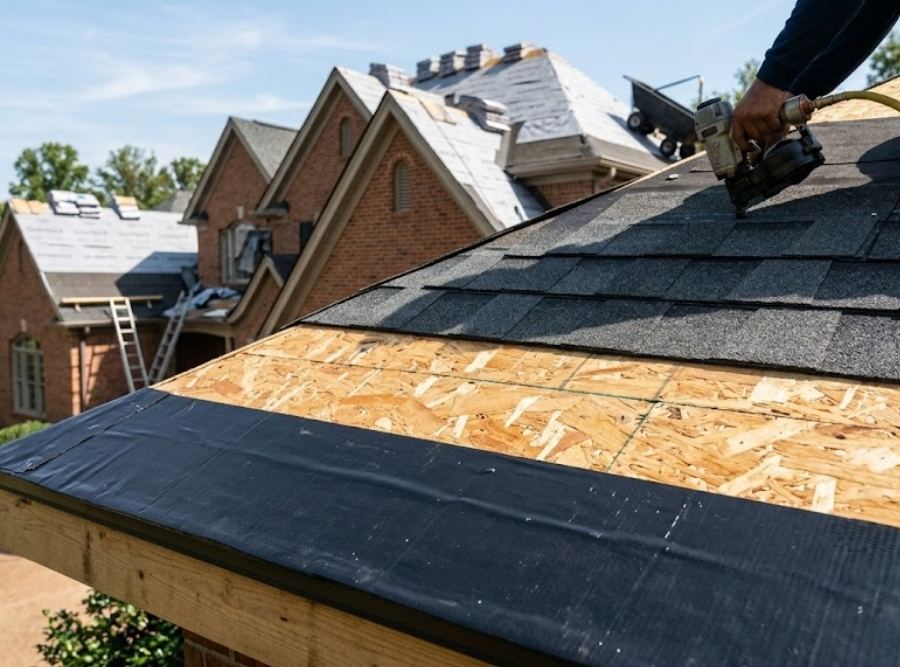
Ice and water shield is a self-adhered membrane installed beneath the shingles to protect the roof deck where water is most likely to get through, including valleys, eaves, chimneys, skylights, walls, and pipe penetrations. Full-deck coverage can be a worthwhile upgrade on complex, tree-covered, or higher-value Brentwood homes because it creates a stronger secondary water barrier against wind-driven rain, but it does not replace correct flashing, ventilation, or shingle installation.
The name “ice and water shield” makes the product sound like something designed mainly for homes in colder northern climates. That leads some Brentwood homeowners to assume it has little value in Middle Tennessee, where prolonged ice dams are less common than severe thunderstorms, heavy rain, high winds, and intense summer heat. In practice, the “water” part of the name is often more relevant here than the “ice” part.
A Brentwood roof may look perfectly sound from the yard and still allow water beneath the shingles during a hard, wind-driven storm. Valleys carry concentrated runoff, chimneys and dormers interrupt the normal flow of water, and every pipe boot, skylight, vent, and flashing transition creates a place where the roof system must be detailed correctly. Ice and water shield adds protection beneath those vulnerable areas by adhering directly to the roof deck and sealing more tightly around fastener penetrations than ordinary underlayment.
The larger decision comes during roof replacement, when homeowners must choose between using the membrane only in vulnerable locations or installing it across the entire roof deck. Full-deck coverage costs more, and it is not automatically necessary for every Brentwood home. Its value depends on the roof’s design, exposure, existing leak history, material system, attic configuration, and how strongly the homeowner wants to reduce the risk of water reaching the decking if the shingles or flashing are compromised.
The Roof Can Shed Water Without Being Completely Waterproof
One of the most important things to understand about an asphalt shingle roof is that the shingles are designed to shed water downhill. They overlap so rain normally runs across the surface and into the gutters, but they do not form a sealed waterproof shell over the house. Strong wind can push rain sideways or uphill beneath the shingle edges, and damage from falling limbs or lifted shingles can expose the layers underneath.
This is why underlayment is a necessary part of the roofing system. Standard synthetic underlayment creates a water-resistant backup layer beneath the shingles, while ice and water shield is a thicker self-adhered membrane intended to provide greater protection in places where water entry is more likely. Because it bonds to the decking rather than simply being fastened over it, it is better suited for details where concentrated runoff, wind pressure, snowmelt, or flashing transitions increase the risk of intrusion.
That distinction matters during Brentwood’s severe thunderstorms. A roof may perform normally during light, straight-down rain but leak when strong winds drive water against a chimney, dormer wall, valley, or roof edge from a particular direction. The shingles can still look intact afterward because the problem occurred within the layered roof system rather than through an obvious hole in the roof.
Ice and water shield gives that water another obstacle before it reaches the wood decking. It does not make poor workmanship acceptable, and it cannot correct improperly installed flashing, but it can reduce the chance that water bypassing the outer roof covering immediately becomes a decking or interior leak.
Where Ice and Water Shield Protects a Brentwood Roof the Most
The most valuable locations for ice and water shield are usually the places where water concentrates or where the roof covering is interrupted. Valleys are a clear example because two roof planes direct runoff into a relatively narrow channel. During the prolonged downpours common in Middle Tennessee, a valley can carry a large volume of water, making underlayment and installation details beneath it especially important.
Eaves and lower roof edges are another common application area. These sections may be exposed to wind-driven rain, occasional freezing conditions, gutter backups, and water moving beneath damaged starter shingles or drip edge. Although Brentwood does not experience the same prolonged winter conditions as colder parts of the country, short freeze-thaw events and heavy rain can still expose weaknesses along the roof perimeter.
Chimneys, skylights, dormers, sidewalls, and plumbing penetrations also benefit from additional membrane protection because they rely on carefully installed flashing to redirect water. These are some of the areas where we most often trace leaks that appear mysterious from inside the home. A ceiling stain near a fireplace, for example, may originate where wind-driven rain entered around chimney flashing and then traveled along the decking or framing before becoming visible indoors.
Complex Brentwood homes may contain many of these vulnerable details on a single roof. Properties in areas such as Governors Club, Annandale, Princeton Hills, or neighborhoods off Concord Road and Wilson Pike often have larger roof systems with multiple valleys, dormers, hips, chimneys, and intersecting planes. The more transitions a roof has, the more opportunities there are for water to find a weak detail if the outer roofing layer is damaged or the flashing eventually deteriorates.
Full-Deck Coverage Creates a Stronger Secondary Water Barrier
With a standard installation approach, ice and water shield is placed in selected high-risk areas while synthetic underlayment covers the remaining roof deck. Full-deck coverage replaces that split approach by installing self-adhered membrane across nearly the entire deck beneath the shingles. The goal is to create a more continuous secondary water barrier rather than limiting the highest level of protection to the roof edges and critical transitions.
This can be valuable when shingles are lifted or torn away during a storm. It can also help when wind pushes rain beneath otherwise intact shingles or when a falling branch damages part of the roof covering. Instead of water immediately reaching a mechanically fastened underlayment with many exposed penetrations and seams, it encounters a membrane bonded directly to the deck.
The self-sealing quality around roofing fasteners is another important advantage. Thousands of nails penetrate the underlayment during shingle installation. A self-adhered membrane is designed to seal more closely around those fasteners, while standard underlayment primarily relies on proper shingle coverage and drainage to keep water from reaching the penetrations.
That added protection should still be described accurately. Full-deck membrane makes the secondary barrier more robust, but it does not turn a steep-slope shingle roof into a permanently watertight system. Water can still enter through improperly detailed flashing, damaged penetrations, poor transitions, or construction defects. The upgrade reduces risk; it does not remove the need for skilled installation or regular roof maintenance.
Why Full-Deck Protection Can Make Sense on Certain Brentwood Homes
Brentwood has a wide range of housing styles, from older ranch and traditional brick homes near Brenthaven, Meadowlake, and the Old Smyrna Road corridor to large custom and executive homes in newer communities. The value of full-deck membrane is not the same across every property. A simple gable roof with few penetrations and excellent storm exposure protection presents a different risk profile from a steep estate roof with multiple valleys, dormers, chimneys, skylights, and tree coverage.
Homes surrounded by mature trees may benefit more from enhanced protection because branches and debris can damage shingles during severe weather. Leaves, twigs, and organic material can also accumulate in valleys and slow drainage, keeping portions of the roof wet longer after rainfall. If the outer roof covering is damaged or water is pushed beneath it, a continuous membrane gives the decking more protection while permanent repairs are arranged.
Full-deck coverage may also make sense for homeowners who plan to remain in the property long term or who would face particularly expensive consequences from interior water damage. A relatively small roof leak can damage insulation, custom ceilings, cabinetry, wood flooring, wall finishes, and electrical fixtures. On a higher-value Brentwood home, the potential interior repair cost may make additional protection beneath the shingles easier to justify.
Another good candidate is a home with a history of leaks during wind-driven storms even though no obvious shingle damage is visible. Repeated leaks around valleys, dormers, walls, chimneys, or other transitions may indicate that the roof needs more than another surface patch. During a full replacement, correcting the flashing and installing a stronger secondary barrier can address the system more thoroughly than continuing to seal individual symptoms.
When the Upgrade May Offer Less Practical Value
Full-deck ice and water shield is not automatically the best use of every homeowner’s roofing budget. On a straightforward roof with limited penetrations, moderate pitch, good drainage, and properly designed flashing, strategic membrane coverage in vulnerable areas may provide an appropriate level of protection. In that situation, investing in higher-quality shingles, improved ventilation, new flashing, or necessary decking repairs may deliver greater practical value.
Budget priorities matter because a roofing system is only as reliable as its weakest detail. Paying for full-deck membrane while reusing deteriorated flashing or ignoring inadequate ventilation would not be a balanced upgrade. The membrane should complement correct roof construction, not become a substitute for it.
The existing attic and roof assembly should also be evaluated before changing the underlayment system. A full-deck self-adhered membrane can reduce the roof deck’s ability to dry outward, making ventilation, insulation, air sealing, and interior moisture control especially important. This does not make full-deck installation inherently problematic, but it does mean the contractor should consider how the entire roof and attic assembly manages heat and moisture rather than treating the membrane as an isolated product choice.
Homeowners should also be cautious of descriptions such as “leak-proof roof.” No underlayment can support that promise on its own. A membrane may provide valuable backup protection, but valleys still need to be built correctly, pipe boots must remain watertight, chimney and wall flashing must be integrated properly, and the shingles must be fastened according to the roofing system’s installation requirements.
The Extra Cost Should Be Weighed Against the Roof’s Actual Risk
The cost of full-deck coverage depends on the size and complexity of the roof, the selected membrane, labor requirements, deck condition, and compatibility with the roofing system. Because it requires substantially more self-adhered material than a standard targeted installation, the upgrade can add a meaningful amount to a large Brentwood roof replacement. The right question is not simply whether it costs more, but whether the added protection addresses meaningful risks on that particular home.
For a large custom roof with multiple valleys, prominent dormers, several penetrations, mature tree exposure, and expensive interior finishes, the added cost may be reasonable when compared with the disruption and expense of a future water intrusion. For a simpler home with a well-designed roofline and fewer vulnerable details, strategic membrane installation may already provide a sensible balance of protection and cost.
This is also why the decision cannot be made accurately from a generic online price or a product brochure. The roof should be inspected as a system. Its pitch, shape, drainage paths, tree exposure, storm history, ventilation, flashing configuration, and previous leak locations all help determine whether full-deck membrane is a practical improvement or simply an optional upgrade with limited added value.
A trustworthy estimate should explain both approaches clearly. Homeowners should understand where the membrane will be installed under the standard scope, how full-deck coverage would change the assembly, what additional risk it addresses, and which other roofing details still require attention. That conversation is far more useful than being told that the upgrade is either essential for every home or unnecessary everywhere in Tennessee.
Better Underlayment Cannot Rescue Poor Roofing Details
One of the easiest mistakes to make during a roof replacement is placing too much confidence in a single upgraded material. Full-deck ice and water shield can make the roof more resilient, but it cannot compensate for poor nail placement, weak flashing details, inadequate valley construction, missing kick-out flashing, or an unbalanced ventilation system. Those failures can still direct water into the home or shorten the life of the roofing materials.
We see this most clearly when a leak keeps returning after repeated applications of caulk or roofing cement. The visible opening may have been sealed temporarily, but the actual water pathway was never corrected. Water may be entering several feet higher at a wall transition, traveling beneath the shingles, and appearing near a chimney or interior ceiling far from its original entry point.
A high-quality roof replacement should therefore begin with sound construction details. The decking must be solid, flashing should be replaced or rebuilt where necessary, valleys must be configured correctly, pipe boots and roof vents should be integrated into the shingle system, and intake and exhaust ventilation should work together. Ice and water shield then adds protection to an already well-built assembly rather than covering mistakes underneath it.
That system-based approach is especially important on Brentwood’s larger and more complicated roofs. More roof planes mean more transitions, and more transitions mean greater dependence on precise workmanship. The best result comes from combining appropriate materials with careful installation, not from relying on the most expensive underlayment to solve every possible problem.
Is Full-Deck Ice and Water Shield Worth It for Your Brentwood Roof?
Full-deck ice and water shield is worth considering when a Brentwood home has a complex roofline, repeated wind-driven rain exposure, numerous valleys or penetrations, mature tree coverage, a history of difficult leaks, or interior finishes that would be costly to repair after water intrusion. It can also be a sensible quality upgrade for homeowners replacing the roof once and planning to stay in the property for many years.
It may be less compelling on a simple roof where targeted membrane coverage, new flashing, sound decking, balanced ventilation, and proper shingle installation already create a dependable system. In those cases, the additional budget may be better directed toward correcting a more significant weakness elsewhere in the roof.
The decision should ultimately come from a thorough inspection and a clear explanation of the tradeoffs. Red Rover Roofing can evaluate the roof deck, drainage paths, flashing transitions, attic conditions, storm exposure, and existing leak history before recommending whether targeted coverage or a full-deck membrane makes more sense. The goal is not to add every available upgrade, but to build a roof system that matches the home’s actual risks and performs reliably through Brentwood’s heavy rain, high winds, humidity, and changing temperatures.