Learn how to identify hail damage on asphalt shingles. Red Rover Roofing explains spatter marks, hail bruising, what insurance adjusters look for, and when your roof needs a claim.
Key Takeaways
Think your roof took a beating in the last hailstorm? Maybe a contractor knocked on your door and told you there’s damage up there. Either way, knowing how to identify hail damage on asphalt shingles — and understanding what insurance adjusters are actually looking for — puts you in a much stronger position when it’s time to file a claim.
Here’s what we look for when we assess hail damage on a shingle roof, and what you should know before your adjuster shows up.
Start with Spatter Marks
The first clue is often the easiest to spot — if the hail event was recent. Over time, a blue-green algae grows on the north-facing slopes of most shingled roofs. When a hailstone hits, it scrubs that algae clean, leaving behind a round, lighter-colored mark we call a spatter mark.
Spatter marks are useful because they’re a quick visual indicator that hail made contact, and the size of each mark gives you a surprisingly accurate read on how large the hailstones were. Keep in mind that not every stone in a storm is the same size, so you’ll typically see a mix of smaller and larger marks across the roof.
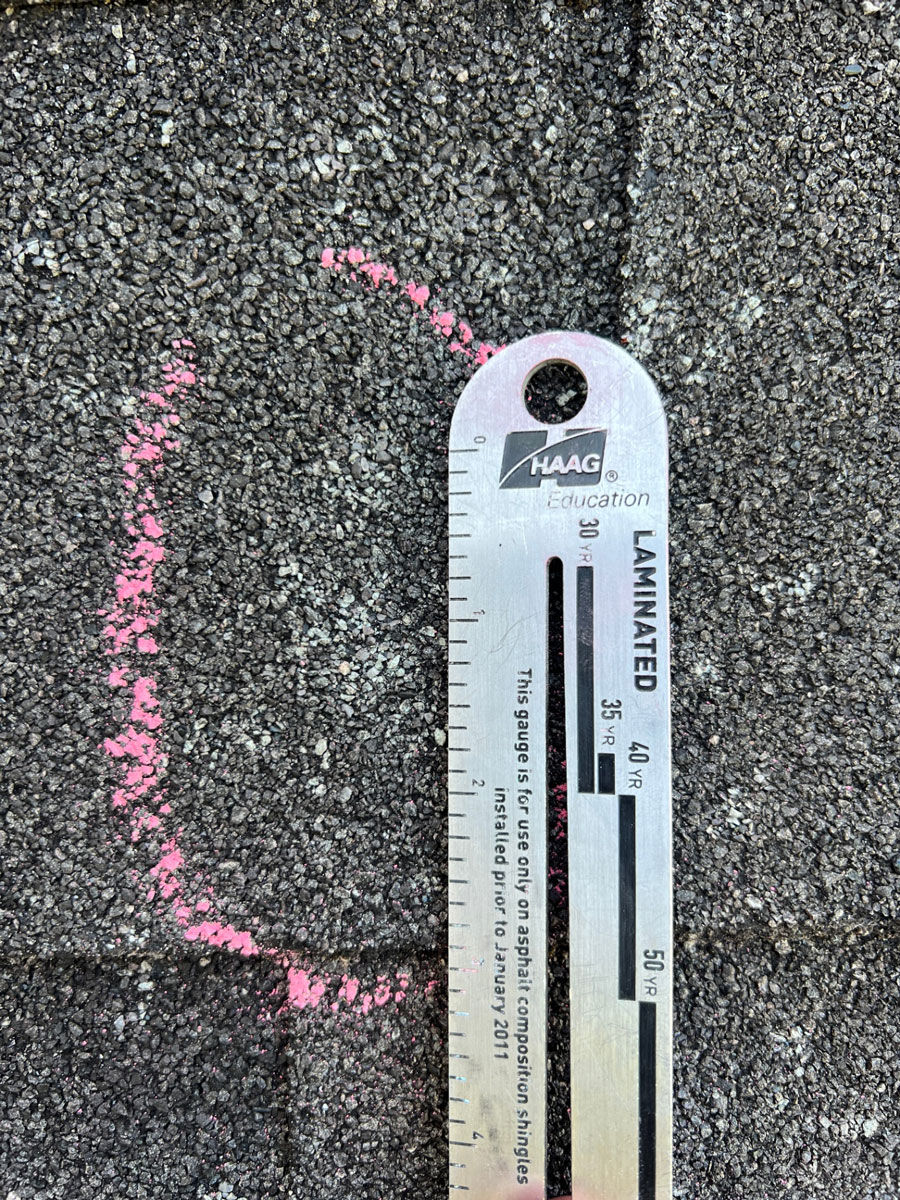
A HAAG gauge placed next to a chalk-circled hail spatter mark on an asphalt shingle — the mark size closely matches the hailstone diameter.
The algae grows back gradually after a hail event. The longer you wait, the harder it becomes to rely on spatter marks as evidence of damage. If you suspect hail damage, get your roof inspected sooner rather than later.
How Big Does Hail Need to Be to Damage Shingles?
This is where things get debated. Roofing contractors and policyholder advocates tend to set the bar lower, while insurance companies and their adjusters typically argue it takes at least three-quarters of an inch to one inch in diameter to cause real damage.
In our experience, unless hailstones are exceptionally hard or driven by strong wind gusts, you generally need at least three-quarter inch hail or larger to damage asphalt shingles. But hail size is only half the equation — the condition and type of shingle matters just as much.
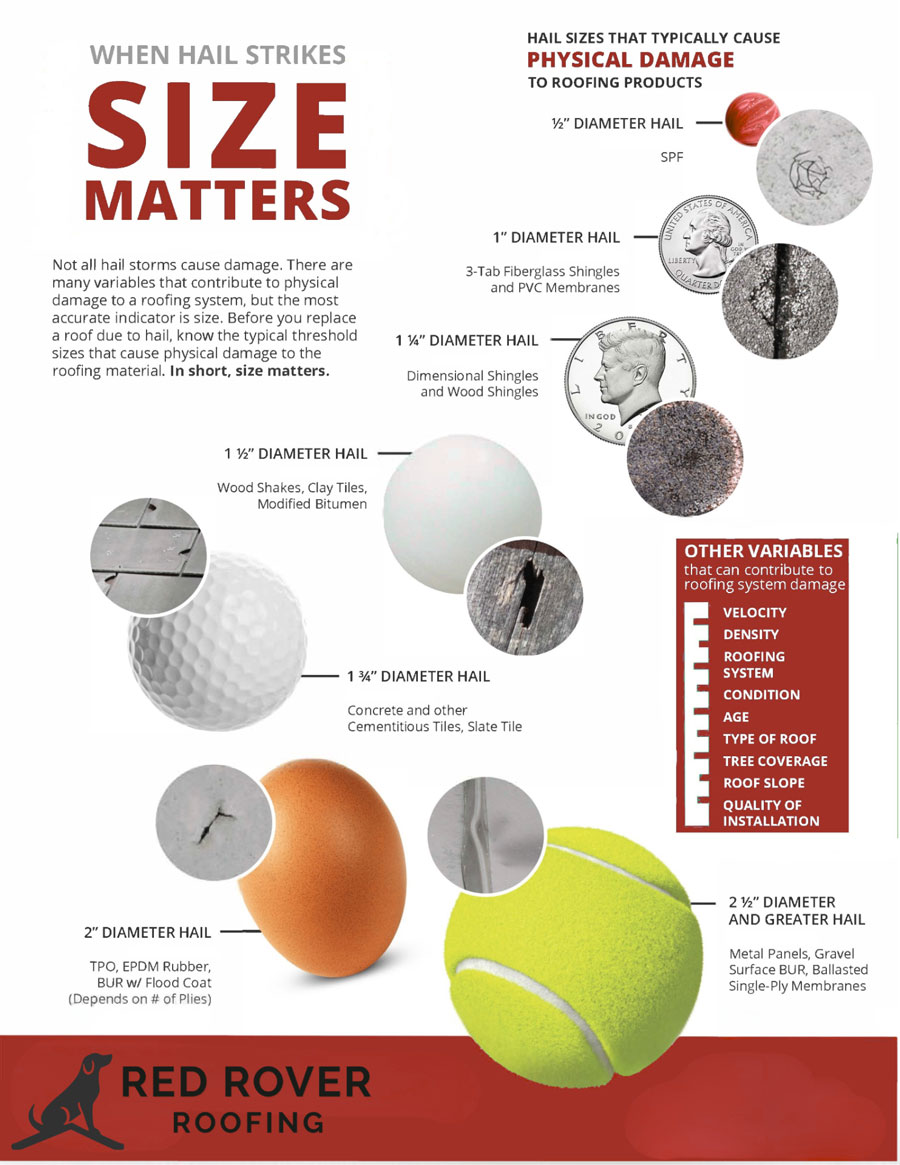
Hail size matters — this infographic shows common hail diameters compared to everyday objects and the damage thresholds for different roofing materials.
Shingle Type Makes a Big Difference
Three-Tab Shingles
These flat, builder-grade shingles hold up to hail surprisingly well. We’ve seen inch-and-a-half to two-inch hailstones hit a three-tab roof and leave almost no damage — while the neighbor’s newer architectural shingles were destroyed by the same storm. Hail resistance is basically their one redeeming quality.
Architectural Shingles
Architectural (or dimensional) shingles start showing damage when solid hailstones reach around three-quarters of an inch. They’re thicker and more textured than three-tab, but that layered construction actually makes certain areas more vulnerable to impact.
Where to Look First: Hips and Ridges
Not all parts of the roof are equally vulnerable. The shingles most susceptible to hail damage are the ones that aren’t fully supported from underneath — specifically, the hip and ridge shingles. These cap the peaks and edges where two roof planes meet, and because they’re bridging a gap rather than lying flat on decking, they can get “punched and crunched” by hailstones much more easily.
When we assess a roof for hail damage, the hips and ridges are always the first place we check.
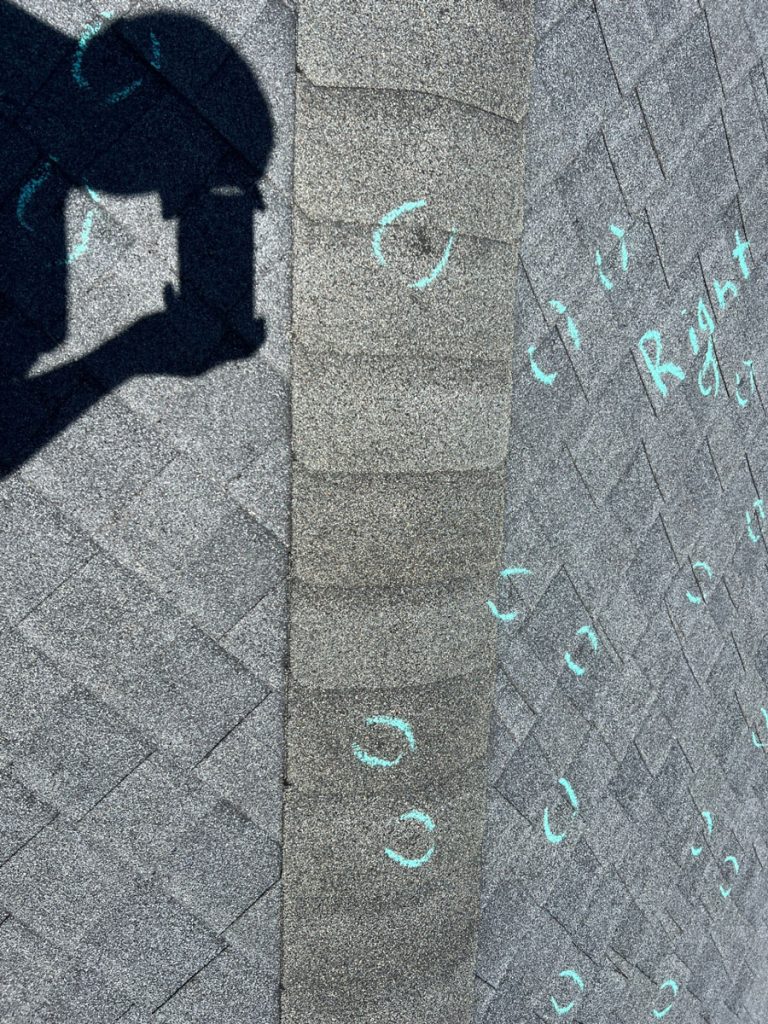
Chalk circles mark individual hail hits on ridge cap shingles — these unsupported shingles are the most vulnerable part of the roof.
Understanding Hail Bruising
When a hailstone strikes an asphalt shingle, it can cause what we call a hail bruise. Here’s what’s happening beneath the surface:
The top layer of a shingle is made up of protective granules. Beneath those sits an asphalt layer embedded in a fiberglass mesh, which gives the shingle its structure. A hail impact can force granules down into the shingle or knock them off entirely. In more severe hits, the fiberglass mesh underneath actually fractures — that’s a shingle whose waterproofing function is fully compromised.
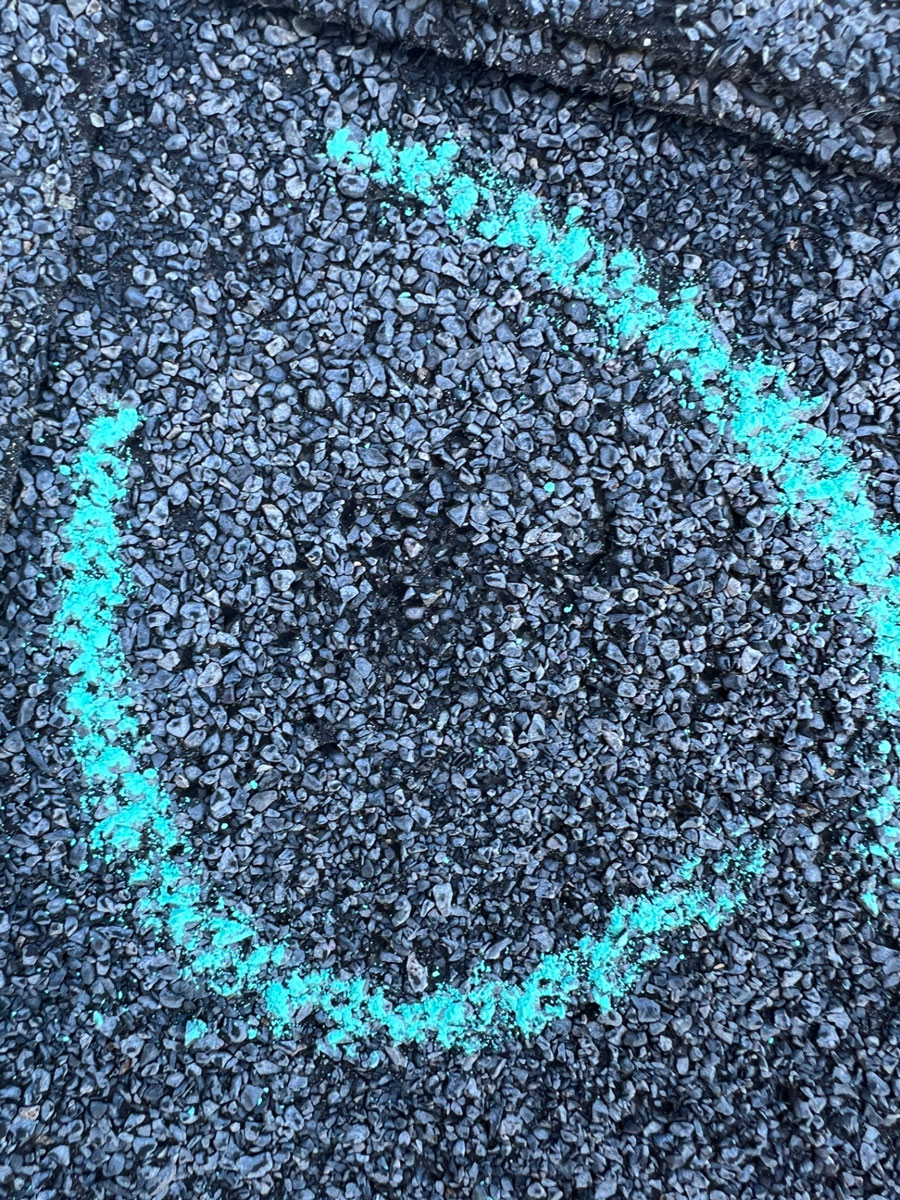
A close-up of a single hail hit circled in chalk — notice how the granules have been displaced, exposing the dark asphalt mat beneath.
But even when the fiberglass stays intact, granule loss alone is still damage. Once those granules are gone, the asphalt core is exposed to UV rays, which accelerates deterioration. The shingle won’t last as long as it would have without the hail event — and that reduction in useful life is exactly what an insurance claim is meant to cover.
Many adjusters focus only on whether there’s bruising (a fractured fiberglass mat). But granule displacement alone shortens the life of the shingle by exposing the asphalt to UV degradation. Both types of damage are legitimate.
How Insurance Adjusters Assess Hail Damage
When an adjuster comes out, they’re going to look at your roof in sections — typically defined as front, back, left, and right (some use compass directions). On each face, they’ll measure out a test square: a 10-foot by 10-foot section, giving them 100 square feet to examine and count hail hits.
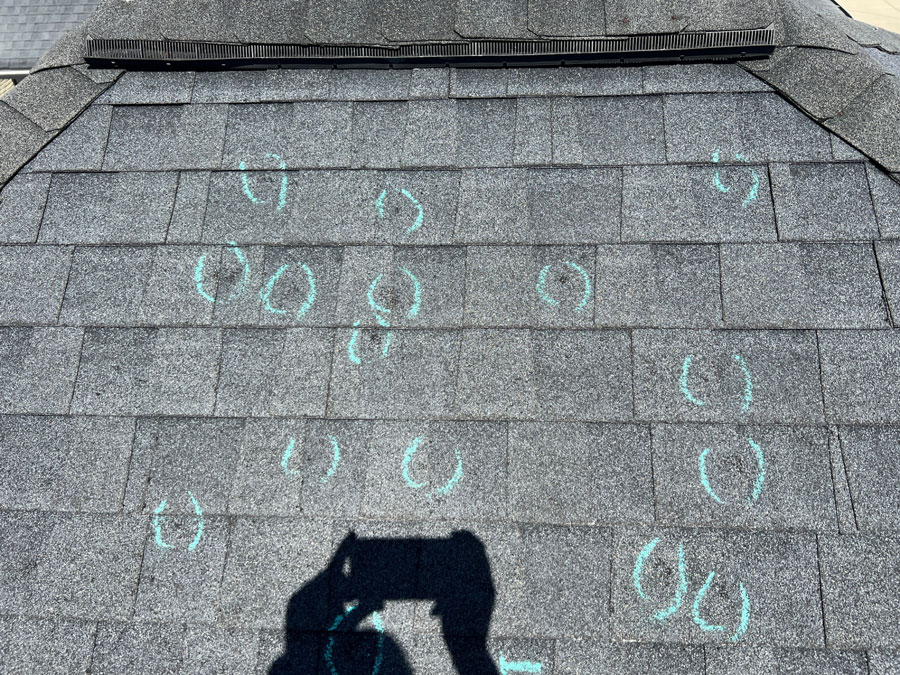
A roof slope covered in chalk-circled hail hits — this is what the test-square counting method looks like in practice.
From there, they extrapolate. If they find eight hits per 100 square feet on the front slope and seven on the right side, those numbers get applied across each entire face of the roof. Most carriers want to see damage on multiple slopes — some require at least two, others three — before they’ll approve a full replacement.
The Threshold Varies
Here’s something most homeowners don’t realize: the number of hits per square needed to “total” a slope isn’t universal. An adjuster on the roof might only need six hits per square, while an inspector sent by the same company could require ten. These guidelines also shift depending on the volume of claims after a major storm — during a large-scale hail event, carriers sometimes loosen their thresholds to process claims more quickly.
In some cases, when weather data shows very large hail (say, two inches or more) hit an address, the adjuster might not even climb on the roof. If they can find one piece of confirming evidence at ground level — like a ding on a garage door that matches the reported hail size — they may approve the entire roof right there. That’s the best-case scenario, but it’s rare.
What Makes a Strong Hail Damage Claim
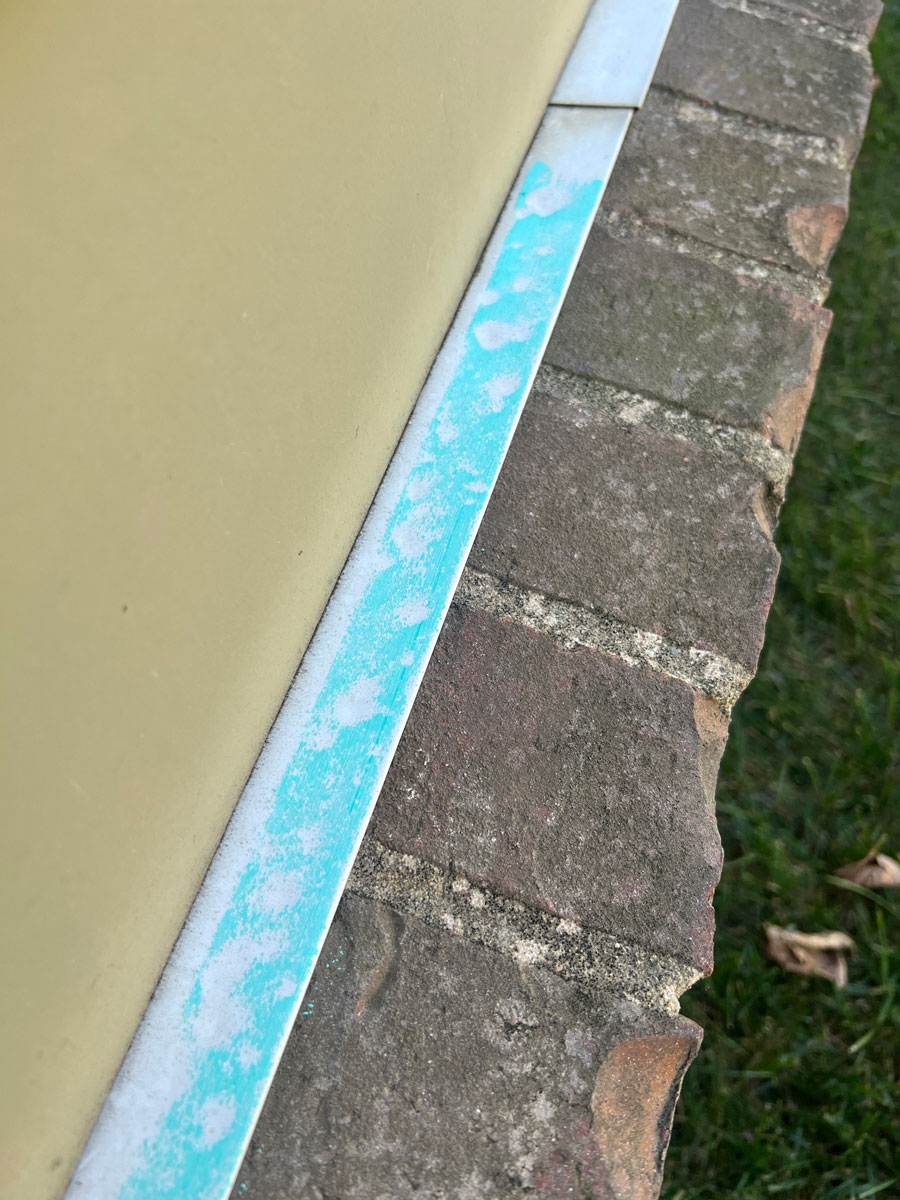
Hail dents on painted metal flashing — collateral evidence like this on non-shingle surfaces strengthens a damage claim.
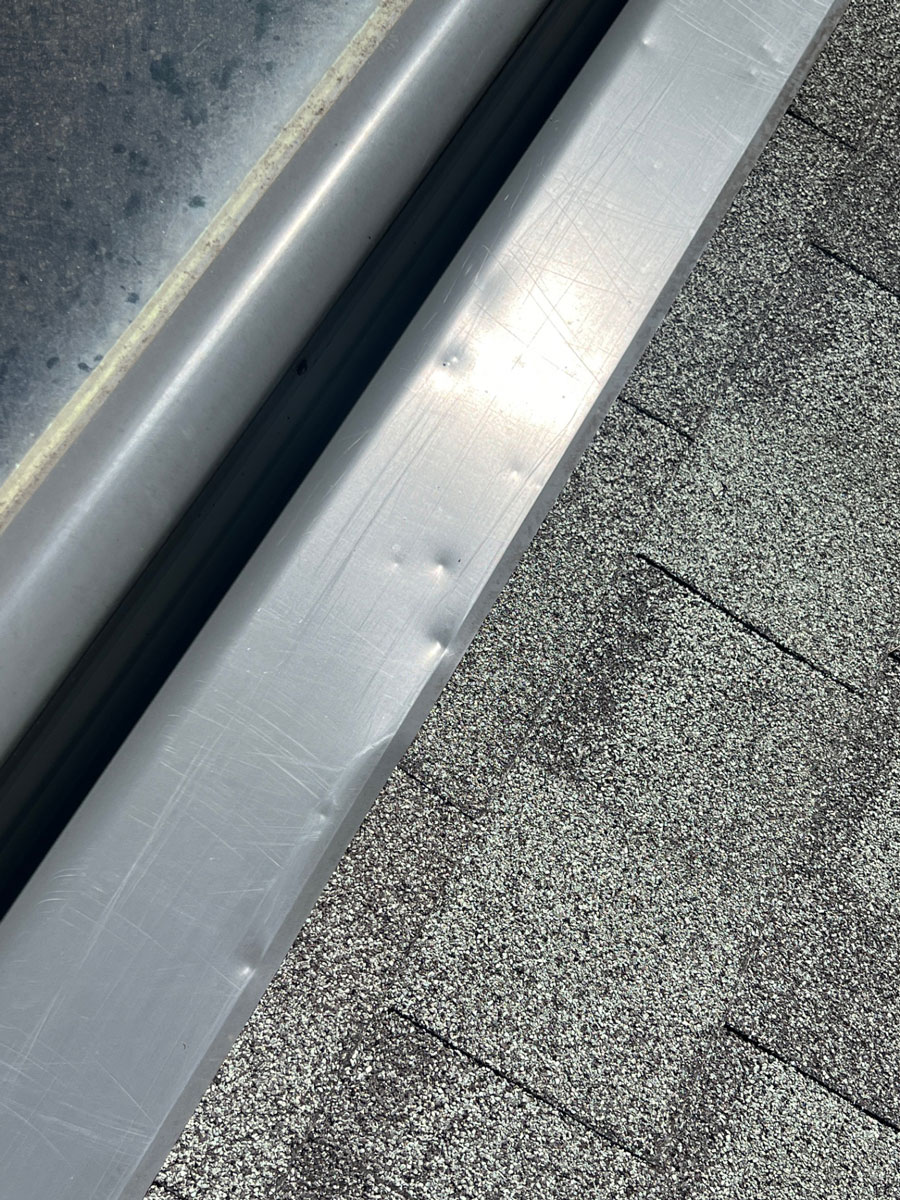
A damaged skylight in Brentwood, TN — skylights, vents, and other roof accessories often show hail impact more obviously than shingles.
The bottom line: hail damage assessment isn’t as simple as climbing up and finding a few dents. It’s a comprehensive evaluation that accounts for shingle type, hail size, damage distribution, and supporting evidence across the entire property. The more you understand about what adjusters look for — and what legitimately constitutes damage — the better equipped you are to navigate the claims process.
Think Your Roof Has Hail Damage?
We’ll do a free inspection and walk you through exactly what we find — no pressure, no games.
Middle Tennessee experiences frequent spring and summer hailstorms, particularly in Williamson, Maury, and Davidson counties. Storms producing three-quarter inch to golf-ball sized hail are common enough that most roofs in the region will face at least one significant hail event during their lifespan.
Need Professional Roofing Help?
Red Rover Roofing provides expert roofing services throughout Middle Tennessee. Get your free inspection today.